Podcast Episode: Recognition Poem

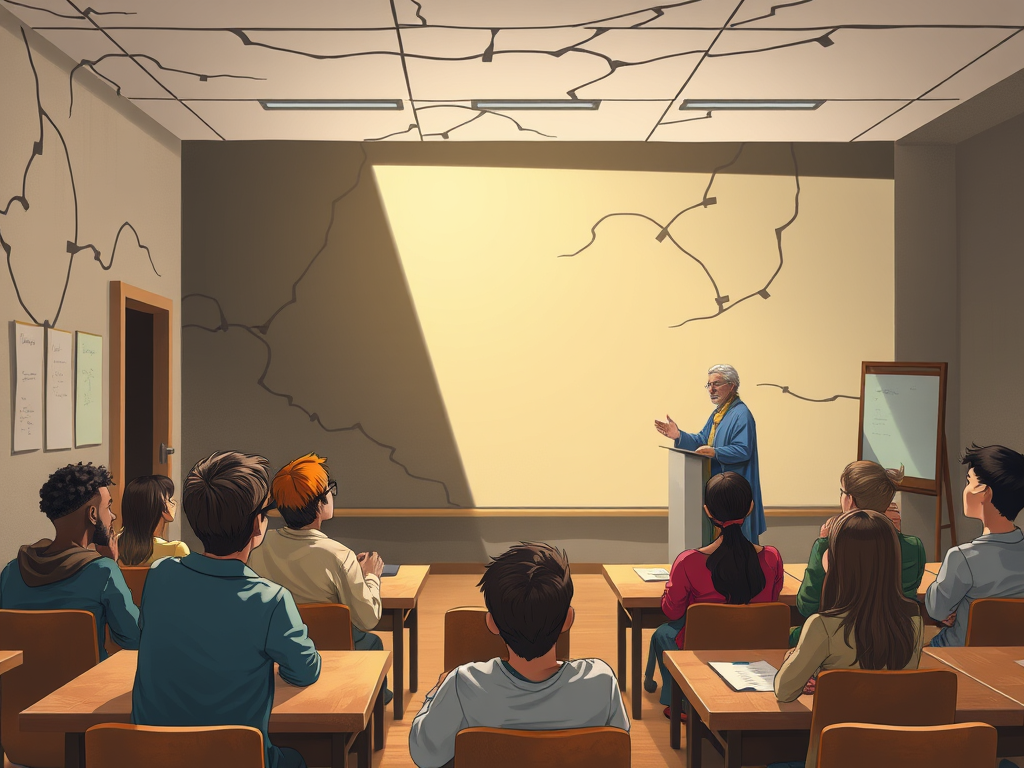
Classroom with students and teacher, Earth and space background blending with room
Students engage in a science lesson with Earth and space visuals surrounding them.

Pip: Classroom Mothership Earth — where the self-help mantra, the bumper sticker, and the geopolitical aside share a page without anyone blinking.

Mara: Today we’re looking at work from Ari Joshua Bouse — specifically a poem that moves from inner recognition and self-talk all the way out to questions of disclosure, technology, and what we owe each other.

Pip: Let’s start with the poem itself — and what it means to truly recognize yourself.

Recognition Poem

Mara: The post opens with a premise about self-perception: that recognition — of yourself and of others — is the starting point, and that self-criticism quietly erodes the ground you stand on.

Pip: The poem names fear as the specific mechanism. Here’s the line that anchors it: “Fear of consequence avoids taking responsibility.”

Mara: That’s the hinge the whole piece turns on. If fear of what follows keeps you from owning what you’ve done, you’re not just stuck — you’re actively building the wall higher.

Pip: And the poem doesn’t let the outside world off the hook either. It moves from inner work outward — through what it calls cognitive distortions, through “Us and Them segregations,” through the idea that karmic consequences exist even when they go unseen and unheard.

Mara: There’s a line that earns its place quietly: “A Higher quality of respect comes from feeling safe to learn, even through peaceful and non-violent forms of tough love.” That’s the connective tissue between the personal and the communal — safety as a precondition for growth.

Pip: The poem then takes a hard turn into territory you don’t usually find between a self-talk mantra and a Latin etymology lesson — and yes, it notes that discipline traces back to the Latin root for teaching, which reframes the whole concept.

Mara: The outer section addresses technology, fossil fuels, and what it calls Full Disclosure — the idea that taxpayers hold a sovereign right to know how their money works. The bumper sticker image is the vehicle: imagine the Air Force holding a bake sale, and then imagine further until there’s nothing left to fund.

Pip: It’s a rhetorical escalation — start with the absurd image, then keep walking until the absurdity becomes the point.

Mara: The closing lines bring it back: “the spotlight of heart-centered mindfulness lays the cards on the table to call out the bluff.” Awareness, the poem argues, is itself a form of accountability.

Pip: Recognition as the first act of honesty — toward yourself, toward others, toward the systems you live inside.


Mara: The thread running through all of this is that seeing clearly — yourself, your fear, your world — is where any real change begins.

Pip: Next time, we’ll see what else comes into focus.

The Batman & Yoda Sessions Revisited

Daily writing prompt
Emperor Palpatine has announced open elections for a new Emperor — and he’s nominated Darth Vader. You get to nominate one challenger.
Armored warrior and alien meditating cross-legged on mossy rock under moonlit forest

Both Master Yoda and Master Wayne aka The Batman had an intention to use their position of power through the power of their presence for the collective good of the order. For this reason, I nominate Master Bruce Wayne aka The Dark Knight for the position of the Emperor…under a wise agreement of the general oversight and spiritual consultation of Jedi Master Yoda.

Some years ago, I had an idea for a story called The Batman & Yoda sessions. Basically, the idea envisioned Bruce Wayne getting spiritual consultation from Master Yoda.

I was always interested in the backstory of characters, particularly the ones that had superhero like qualities, including the villains.

What were they like when they were children?

Did they have trauma histories?

Yoda was always a personal favorite because he was an ET, had lived for nearly a thousand years, and used his powers mostly invisibly and silently; in much the same way as Eckhart Tolle embodies through his presence as a spiritual teacher today.

The reason the Batman character always resonated for me is because his true identity as Bruce Wayne was mortal, as in he wasn’t born with any particular superpowers. However, during his Justice League days, he does answer the Flash’s query about what his superpower was by responding, “I’m rich.”

Although he came from wealthy privilege, Wayne had a significant trauma history, cared deeply for the people that fall through the cracks of systemic barriers, and never gave up on his hometown or the plight of the Planet. Moreover, he had a burning desire to elevate his humanity and inspire the rising consciousness of others.

At the time of this writing, Yoda has already left the 3D realm but still lives on in the spirit realm, and even wiser beyond his years now more than ever. Like myths of Yogis, etc. on Mothership Earth, Yoda dematerialized and died consciously,. Nowadays, he is still able to continue to interact with with the living in a mindful way; at least with those whose consciousness allowed for it.

After becoming disillusioned with Gotham City and Climate Change on Earth, Wayne hung up his cape for good, and got himself into therapy. Moreover, he developed a meditation practice to heal from his own childhood trauma. Shadow work and the Dark Night of the Soul were waiting patiently for allowing the light to illuminate the shadows, if you’ll pardon the spiritual pun.

More importantly, Master Wayne has seen his share of multidimensional villains like Darth Vader and Emperor Palpatine before. Truly, he has had a myriad of experiences with the secondary trauma that he faced during his stint as a high ranking but secret detective who fought tirelessly against the shadowy criminal underground, when he became known as the Prince of Darkness. Master Wayne’s keen intellect, access to and knowledge of technological resources reinforce the vote. Besides, the brother has friends in high places like Wonder Woman and Superman for crying out loud!

Furthermore, Wayne’s flowering experiences with multidimensional reality have opened him up to a personal communion with Master Yoda…arguably the most famous reptilian ET on both Earth and the Cosmos throughout. After seeing through the smokescreen of The League of Shadows, Master Wayne is ready for a promotion. And the promotion will lead to the Galactic Dismantling of the Emperor, Strategic Defense Initiative (SDI) aka STAR WARS; or more accurately what this writer refers to as, Egoic Defense Initiative (EDI).

Looking back at some of his major therapeutic breakthroughs (including letting go of his Savior Complex), Master Bruce Wayne encounters Master Yoda’s spirit in a hidden cave, deep within Mount Shasta. Given Mount Shasta’s Sacred Sites, connection to portals, and a universal-planetary root chakra serving as a Universal inter-dimensional Gatekeeper, Bruce Wayne encountered Master Yoda’s consciousness while in a deeply meditative state there. And yes, there were many bats and lizards hanging out on the cave’s ceilings and cracks and crevasses. It’s as if Bruce & Yoda met up in Plato’s Allegory of the Cave, and then experienced a therapeutically, meditative experience together in visionary co-regulation. The Wise Council of Indigenous Elders & Saint Germain were a key part of their Spiritual Light Team multidimensional communication process.

Bruce Wayne is a mover and shaker, who has a unique ability to schmooze. At the point of this nomination, he has learned how to strengthen his presence in a way that is in alignment with power over force. Like Yoda, he is arriving at a Spiritual Avatar status. In much the same way as Yoda put on his work clothes when called to service, Master Bruce puts on his old cape when duty calls. Given the corruption in the Galactic Federation, the general public resonates with the story of Gotham, Batman and the affairs of Earth. The people there see their multidimensional relationship with our Galaxy and Solar System as connected in consciousness. And like people on Earth, they see a way out of the suffering.

This trick is that Master Wayne and The Batman had to integrate themselves to reflect their light and dark sides to align with the spiritually integrated way of the yin and the yang. Now with Master Yoda readily available as a role model and teacher of consciousness, Bruce Wayne aka The Batman has the right kind of power and resources to give Palpatine aka Darth Sidius and Darth Vader a run for their money. Who knows, Vader might even see himself in Batman and remember his true self as Anakin Skywalker when he notices Bruce Wayne’s authentic transformation.


Podcast Episode: Letting Go Of Getting Stuck In Life By Being Present With Our Stuckness

Woman practicing Tai Chi barefoot on stone path with yin-yang symbol in garden

Check out this newly created experimental AI Podcast feature that aligns with my writing, compliments of WordPress.

Full Disclosure: Truly, I do take pride in my writing, and have yet to use AI for the written word. However, I have been having fun with playing around with AI for illustrations.

This version of 1 of my more recent writings stars 2 AI created characters named Pip and Mara.

Please enjoy the podcast & transcript below:

Pip: Classroom Mothership Earth — where getting unstuck, staying present, and surrendering to the universe are all on the syllabus, and somehow the homework is actually worth doing.

Mara: Today we’re covering work from Ari Joshua Bouse — one extended meditation on what it means to stop fighting your own stuckness and find your way back to the present moment. Let’s start with the heart of it: surrender as a path through.

Letting Go: Presence, Surrender, and Getting Unstuck

Mara: The central question here is deceptively simple — why do we get stuck, and what does it actually mean to let go? Not as a motivational slogan, but as a lived, embodied practice.

Pip: The post opens with a Rhonda Byrne line that stops you cold: “You can’t feel good when you’re feeling bad about feeling bad.”

Mara: That’s the trap in one sentence. The secondary suffering — the judgment layered on top of the original feeling — is often what keeps people frozen far longer than the feeling itself would.

Pip: And the post gets specific about what that looks like in practice. The reflection on getting stuck on other people’s stuckness, and taking it personally, is one of the more honest things you’ll read about how entanglement actually works.

Mara: The post frames it plainly: “experience teaches that it is freeing to stay centered, and observe those entanglements soften and relax.” Letting go of victim consciousness is described as a process — peeling away layers of an onion, not a single decision.

Pip: Which is where Tai Chi enters — not as a detour, but as a structural argument. Ancient meditative movement practices, the post says, integrate the brain’s hemispheres and re-pattern the neurological system toward emotional regulation. The body is part of the solution.

Mara: The post profiles Professor Cheng Man Ching, who brought Tai Chi to the West against the explicit orders of his masters. He once said he was approximately seventy percent Confucius and thirty percent Lao Tzu, and that learning how to be human takes a very long time.

Pip: Seventy-thirty is a surprisingly precise self-assessment for someone also teaching surrender.

Mara: The post also weaves in bibliotherapy — a medium using reading, film, podcasts, and other materials to support therapeutic change, especially between sessions. It traces back to an independent study in college exploring how clients get unstuck outside the therapy room.

Pip: That thread runs all the way to Pema Chodron, whose work the post closes with — a veteran Buddhist teacher the post credits as a leading force in bringing these principles to Western audiences.

Mara: The throughline is consistent: whether it’s Tai Chi, bibliotherapy, or sitting meditation, the practice is always about carrying the insight off the cushion and into ordinary life.

Pip: Stuckness, it turns out, is less a destination than a habit — and habits, given enough momentum, can be re-patterned.


Mara: Surrender as a technology for change — that’s the real thread running through all of this.

Pip: Next time, we’ll see what else the mothership has on the curriculum. There’s always more to unpack.

Please enjoy the original post that inspired this podcast at the link below:

Take care of yourselves everyone,

Ari

Podcast Episode: A Crazy Business Idea For Co-creating A Beautiful New World

Child standing in a futuristic classroom looking at Earth through large space station windows
A student gazes out at Earth from a high-tech space classroom

Check out this newly created experimental AI Podcast feature that aligns with my writing, compliments of WordPress.

Full Disclosure: Truly, I do take pride in my writing, and have yet to use AI for the written word. However, I have been having fun with playing around with AI for illustrations.

This podcast version of 1 of my more recent writings stars 2 AI created characters named Pip and Mara.

Please enjoy the podcast & transcript below:

Pip: Classroom Mothership Earth — where the daily writing prompt is “come up with a crazy business idea” and the answer turns out to be: civilization, but better.

Mara: Ari Joshua Bouse takes that prompt seriously, and today we’re following the thread — from a vision of shared consciousness and cooperative economics to what it actually looks like to clear space, inside and out.

Pip: Let’s start with the business idea itself.

A Crazy Business Idea For Co-creating A Beautiful New World

Mara: The post opens with a genuine question: what does an economy look like when the underlying operating system shifts — when interconnection is the default, not the exception?

Pip: And the answer isn’t a product or a pitch deck. It’s a paradigm. The post lays out what falls away when people genuinely feel their connection to each other.

Mara: The list is specific: “the institutionalized isms, trashing the park, wars, violence, gang banging, organized crime, the so called legitimate maximum-economic profit capitalist conditioning, economic strangulations, and the need to control each other fades away, and is released into a black hole in the Universe.”

Pip: That’s a sentence doing a lot of heavy lifting — and the point underneath it is real. The argument is that these patterns aren’t permanent features of human nature; they’re symptoms of a particular kind of disconnection.

Mara: Right, and the post is careful to say it doesn’t get killed or die — it transforms. The balloon metaphor follows: letting go of a thought form so it floats away, rather than fighting it.

Pip: There’s a friend in the piece who’s been sober from the news for over a year and reports genuine levity — less charge around politics, less reactive energy. That’s offered as a small proof of concept.

Mara: The post connects that to The Celestine Prophecy — James Redfield’s intention, quoted directly, was to inspire readers to “reclaim their power from dominant authorities and dysfunctional relationships: not via political or legal action but through a personalized spirituality that portrays life as a meaningful journey toward self-actualization.”

Pip: So the crazy business idea is essentially: skip the legal filing, go straight to the consciousness upgrade.

Mara: The post also gets concrete about physical space — imagining trash compressed in a way that literally opens up room, turning what looked like a landfill into ground for new growth. It’s the same logic applied materially.

Pip: And the T’ai Chi section earns its place. Professor Cheng’s instruction to “be like a ghost” — to create spaciousness — maps directly onto the economic argument: lead, follow, listen, don’t force.

Mara: The upshot is that cooperative competition, in this frame, isn’t naive. It’s more like push hands than a zero-sum match — sensitive to the other’s energy, not trying to overpower it.

Pip: Which makes the closing meditation clip feel less like an appendix and more like the actual deliverable.

Mara: That thread — from inner clearing to outer structure — is what the whole piece is building toward.


Pip: Clear the space, transform the pattern, don’t fight the balloon — it’s a coherent through-line once you follow it.

Mara: More from Classroom Mothership Earth next time.

Please enjoy the original post that inspired this new podcast version at the link below:

Take care of yourselves everyone,

Ari

Happiness As A Way Of Life Does Not Mean That You’re Happy All The Time

Daily writing prompt
What’s a common misconception people have about happiness?
Rural landscape with sun rays breaking through dark clouds over green fields

I remember when I worked with a single parent who said, “I just want my son to be happy.” Regardless of where they are at in their life cycle, that’s what most parents want for their children.

But there is a difference between getting what we want, things not going our way and experiencing happiness as a way of life.

Awareness of the truth that we all suffer and that desire and attachment are the root of suffering is key to unlocking a common misconception about happiness.

Happiness as a way of life recognizes that an open, passive attitude and mindful approach by allowing the present moment to unfold as it will (regardless of what feelings we’re being visited by), is what’s up.

Moreover, it is freeing to be present with softening our sense of craving that often accompanies happiness (like any other state of being)- pleasant, unpleasant or neutral.

We often crave moments to happen or not happen . . . Or by wishing them to begin or end in ways opposite of what’s really going on.

Moments are what they are. We are the one’s that project our “stuff” onto them. We’ve all done it.

Truly, these moments are what they are, and will be nothing more than fleeting or transient.

Might as well be curious about these moments as they arrive, and surf them as they happen, like riding a wave with the grace of a swan.

Just as an example, the pursuit of happiness is a setup in our constitution, if you’ll pardon the multidimensional-revolutionary pun.

Pursuit connotes suffering. Like striving, being in pursuit of something is really just another unattainable craving because the pursuit of something (such as an attached mental concept) never really happens.

Or if it does happen that you manifest, reach your goal or get what you want . . . chances are that you missed the magical moments of the process as they unfolded because you were still in hot pursuit of reaching your lofty ideal.

Perhaps you identify with a dystopian view of your lowest self portrait. Comedian George Carlin captured the sentiment in my favorite one-liner by stating, “if my goal is to fail and I succeed, which have I done?”

Happiness is seeing beyond the smoke and mirrors, bells and whistles, and bling in the world of 10,000 things.

Happiness is the radical self-acceptance that an interplay between form and formless are always flowing together. Happiness as a way of life lives in a space that transcends the clinging and grasping to our judgments, justifications and mental concepts.

Like the old saying, it’s the journey not the destination.

Take care of yourselves everyone,

Ari

Remembering Feeling Inspired By An Old College Professor’s Wisdom

Daily writing prompt
What is something you wish you could tell your 20-year-old self?
Elderly professor smoking a pipe sitting at a wooden desk with books and papers

As this writer reflects on this writing prompt, he looks back on the time when his 20ish year old self was hearing prophetic wisdom from one of his favorite teachers during his tenure as a college student.

Mr. Easton was an English professor, a writer and a charismatically eccentric man. And I have come to believe, as he did, that everyone has a writer living within their Being.

Further, during an Advanced Composition class; it was late in the Spring semester, and for many of us, our college careers were winding down. Because Mr. Easton was a very present person, he probably sensed our anxieties about our prospective unknown futures, saw the teachable moment, and deviated from the class lesson plan.

Footnote: Unlike most of the professors at my Alma Mater at that time, Easton did not have his Ph.D. And yet to many of us, he was among the smartest and most engaging teachers on the faculty.

Back To School . . . Near the tail end of one particular class, Easton elaborated on how we should “hang in there, I promise . . . you’ll see that in your 30s, it starts to get better.”

Of course that’s true and it’s not true. There are no guarantees. If we don’t work at our mental health, then our mental health issues just don’t magically go away.

Speaking of Polaroids, another Kodak moment featrured Easton encouraging us to “take lots of pictures” at various family events, “because people get older and you never knew who would still be around at the next gathering.” He emphasized that the gatherings were important experiences, as well as good opportunities to capture moments through pictures, and then tell stories to remember our connections and loved ones.

Since that time, Easton’s wisdom still sounds true. Moreover, I serve it up to my 20 year old self; as well to all of the 20 year old selves out there making the track through life. While it’s cool to be in the moment, it’s important to have a longitudinal view in life.

Keep in mind that there is something to be said for hanging in there. Get up. Stand Up. Find your passion. Nobody else is going to do it for you. But everyone needs a little hurdle help sometimes. We’re hear to lift each other up rather than tear each other down.

Or like the Beastie Boys sentimental anthem, you gotta fight for your right to party!

And you can’t to that in this incarnation unless you are still breathing!

Nowadays, I use meditation to time travel back to my old self by envisioning peaceful, calming thoughts; coupled with a gentle and soft heartfelt approach of self-compassion that includes a forgiving attitude of gratitude and radical acceptance for what is.

Take care of yourselves everyone,

Ari

A Positive Thing A Family Member Has Done For Me

Elderly man handing grocery bags to a woman and child at the door

I remember when Grandfather would sometimes stop by for a surprise visit with some bags of groceries during my Elementary School days.

There was plenty more good that he did while our lifetimes intersected, but this experience still lights up my soul to this day.

Grandfather was a gifted storyteller, witty and could be charming. But more often than not, he was stoic, humble, the strong silent time, and didn’t do drama.

But he had a big presence, and when he showed up, he would smile and say something like, “well, I was just in the neighborhood and I thought maybe you guys could use some groceries.” At that time in my life, my Grandparents didn’t live more than a 5 minute drive away.

Of course like we’ve all heard; growing up being raised by a single parent wasn’t easy for me, nor is it on anyone else.

But extended family played a significant role in my life, and this example of how Grandfather looked out for us has always stuck with me.

During this time period in their life cycle, my maternal grandparents were in a more comfortable position in their lives financially. By this time, they were empty nesters, expanded their social network, and had the opportunity to travel the planet and experience different cultures. I always appreciated how they would often bring me back a new t-shirt that I would proudly sport at school. Fashion has never been my bug, but I always felt like those t-shirts externally reinforced my intrinsic uniqueness.

Grandfather had been orphaned by the untimely death of both of his parents by the time he was 19. He would always say that “we were poor but didn’t know we were poor. We had food to eat, and we played and had fun as kids.” And then he would always say that Grandmother grew up a different kind of poor, as in, Appalachia like abject poverty. She never saw a dentist till she was 18, when she walked in a clinic off the street with bleeding gums and no money to pay for dental care.

These days, many people, like my own daughter, still tend to call themselves adults by 18 or so. But the truth is that we are still adolescents till our mid-20s from a developmental and psychological perspective.

College wasn’t an option for either of my grandparents or their peers from their old St. Louis neighborhoods back then. Later in life, they would tell stories about their newer peer network who went to college, how they had dreamed about their own children going to college someday, and then me by the time I came along.

Parenting back then; especially for folks that grew up like my grandparents, involved a lot of financial stress and winging it. Of course there’s still plenty of all that in parenthood today.

As I got older, I remember asking Grandfather about consciously envisioning a life plan or planned parenthood back when they were starting out as a couple. And Grandfather would chuckle and say, “naw…but sometimes we’d look around and say, what the hell are we doing with all these kids?”

These days, many folks are familiar with the term Food Insecurity to describe the anxiety that connects to the insecurity about when or where your next meal might come from, if at all.

In my case, I had the good fortune to grow up around all kinds of people from diverse racial, ethnic, cultural and socio-economic backgrounds. Some of my peers at school arrived from other lands with English not being their first language. At that time, the land we all lived in was called the MidWest.

And it wasn’t lost on me that I was only a fragile step away from what some of my peers were going through, who were part of the Cycle of Poverty, on the fringe or falling through the cracks.

But the difference in my case was that I was privileged to have someone like Grandfather looking out for my mom and me.

Finally, it is with a deep sense of appreciation and gratitude that I feel for the way that Grandfather chose to look after us, even though he wasn’t obligated to.

Cat & Mouse Is What I Do

Daily writing prompt
Do you play in your daily life? What says “playtime” to you?

I remember when I embarked on an adventurous family reunion in Italy many years ago, and one of my cousins looked at me, and said, “Ari, is it fun in there?” She was referencing my mind, and made this comment after I cracked a barrage of puns, and other theatrical wit. Perhaps if my Italiano was better, then I could have disguised my cornball humor so that it would have read like a foreign language.

And then many moons later, I worked for a new School Principal who brought with her a book called Fish Philosophy into the school community we worked in together at the time. As our new administrator, she built in Fish Philosophy into our staff professional development to enact cultural norms encouraging us to “choose your attitude” and “make their day.”

The theme of Fish Philosophy is simple and was adopted from the famous fish market in Seattle, where the workers throw fish at each other, customers and have fun doing it. Imagine that . . . work and play going together, and that we have a choice in whether we do that or not in the school of life. Before I even read any of the book, a new coworker came up to me after a work related training, and made it a point to tell me that he had started reading the book, and said that I was a good role model of the book’s theme.

https://www.pikeplacefish.com/about

Since before I came out of the womb, I’m sure the cat and mouse part of my personality wasn’t part of my hidden self. As a boy, my mom said that I liked it when she read to me in the womb. Truly, I was probably already acting out the characters that she was reading to me. Most of the trouble I got into in school by teachers, and later in sports by coaches was my clowning around with people, and finding parody and jest in the everyday mundane encounters.

For example, one of my favorite coping strategies to introduce to kids (and adults) is the idea of imagining that the business of life is like playing a video game in your head. It’s been since I was in Middle School that I was a regular video game player, but when I came across that strategy, it resonated in me and many other students I worked with over the years. The Tai Chi classes I have taken also emphasized and embodied the idea of playing with form.

These days, most people expect to be entertained, and typically by someone or something else that they perceive to be outside of themselves; as in an external object of affection, like a pacifier. But the real trick is to discover ways to play with life. As other people take notice, it does tend to become contagious.

Just as an example, I like to play around with mindful breathing during a workout or exercise routine because it brings you into the present moment. Breathing mindfully also makes the workout or exercise routine feel less like work, exercise or a routine for that matter. And when I play my guitar, that’s all I’m doing is playing. It’s more fun that way.

Plato’s Allegory Of The Cave

Daily writing prompt
Describe something you learned in high school.

Back in High School, one of my favorite classes was an elective called Humanities. The course was created by a great teacher who brought his theatrical personality, and philosophical spirituality to the classroom. In short, he embodied his humanity, if you’ll pardon the pun.

Our class ran like a group, which ended up being a precursor to some of my social work classes later on in graduate school. Seating arrangements could look like a traditional classroom with rows, or perhaps more avant guard small groupings of desks or resemble a horseshoe configuration. These seating arrangements and rearrangements are pretty typical and more commonplace in today’s classroom environment to help keep the energy flowing to facilitate the learning process.

In my case, going down multidimensional mind trips and wormholes wasn’t a new experience for yours truly. But in this class, the expanding group consciousness was unfolding in our classroom. In my experience, it was easier to come in and out of realms; somewhat akin to a UFO hovering in and out of dimensional bleeding between realities.

As always for yours truly, the classroom and school environment was anything but boring to a guy like me. To my teacher’s chagrin, it wasn’t typically the lesson plan that captivated my attention. Humanities class was a different story. We explored differentiation between Plato’s Republic and Pericles’ Democracy, our teacher’s own ‘Theory of Good’, and read Herman Hesse’s classic book entitled Siddhartha, among other curricula.

Looking back zen, Plato’s Allegory Of The Cave really struck a chord in me that has remained like a light flickering in a shadowy cave, if you’ll pardon the pun. This class really exposed some of the chinks in my armor that were key dynamics to my protective survival instincts at that time.

Furthermore, the metaphor of humanity being asleep and trapped in own own darkness lit a fire in my neurons and energy field. Death and rebirth were beginning to take root in my psyche, as they had done earlier in my formative years. I’d never heard of higher level thinking, metacognition or superconsciousness as common language experiences yet. But that didn’t stop me or others from having them. I remember when our teacher chalked up a simple diagram of his take on Plato’s Allegory of the Cave on the old school blackboard. As I reflect right tao, this visual resembles the ancient cave art we see from our ancestors. What can I say, the novel learning experiences still resonate.

Take care of yourselves everyone,

Ari

A Full Strawberry Moon, Spirit Of Gemini & The Rays Of Summer Solstice . . .

Photo by Susanne Jutzeler, suju-foto on Pexels.com

A Strawberry Full Moon will happen on June 3 or 4, depending on where you are on the Planet. Like all Full Moons, our ancestors named them based on what energies they saw reflecting back to them as humans in the naturalistic environment.

May we reawaken their organic observations from their spiritual fieldwork, rekindle our co-regulative connection with Nature and reclaim divine wisdom from the Heavens.

For example, many Indigenous people from North America noticed the spread of wild strawberries at this time. In China, it is called the Lotus Moon and is also know cross culturally around the Earth as the Garden Moon, Planting and Mead Moon.

And then a New Moon in Gemini will happen on June 18, which reflects changes and spontaneity. May we perceive a safety net when thinking about our feelings and sharing them with others. Meditation on Gemini can support us in expressing ourselves and speaking our truths more effectively right now.

Perhaps we will keep a cool head rather than a cold heart because the latter can discourage others or come across like you are being dismissive of their feelings. Remember that harmony of thinking and feeling is important, although it is not always easy for these areas to align with each other in our soulful dance steps.

Right after the New Moon, the Summer Solstice will happen on June 21st. Energetically, this is a powerful time for manifestation of the new self that wants to grow outward and expand. This time represents peak sunlight because it is the longest day of the year.

Conversely, in the Southern Hemisphere, it will be their Winter Solstice and darkest day of the year. In death, there is rebirth. One way to heal polarity consciousness is to integrate these two opposite sides of the same coin into an aligned perspective of inclusivity and wholeness. If you buy into a membership has its privileges mantra, then what has secured an attachment into your energy field?

Remember the mantra Diversity Within Unity is the new path into a New Age and Paradigm. May we make this transition together as gracefully as possible. Regardless of how you identify- male, female, non-binary, gender fluid, LGBTQ or BIPOC; these are examples of Diversity Within Unity.

We are all part of one human family with diverse expressions. Besides, the psychologist Carl Jung wrote about how every man and woman have both energies flowing within our being. Jung called this experience the anima and animus.

Notice how the light and dark are always seeking balance because we can’t have one without the other. While there is more yang in the sun of summer, there is still a need for the yin-ward femininity of the moon. Without the softness of dark waters, the light would be scorching and blinding.

We are part of the Earth and also part of the Cosmos. Paradoxically, Mother Earth’s dirt is in our bones, and yet there is also stardust in our DNA. As one interconnected family system, may we realign with the rhythms of Nature and reconnect with the sacred ways of our co-regulative connection with the Earth and the Heavens.

Visualize the right and left hemispheres of your brain in fluid communication with each other because this promotes plasticity of the mind. You’ve all heard the saying that there’s nothing more devilish than fixed ideas or mental rigidity. That’s how we awaken to expanding consciousness.

Meditation on the picture above awakens the doubly gentle softness of a snail’s pace, as well as a friendly reminder to be berry kind to your mind, if you’ll pardon the pun.

Take care of yourselves everyone,

Ari