“As the sun moves through Libra before crossing into Scorpio’s shadowed terrain, October asks us to trade politeness for truth. In the Northern Hemisphere, the days shorten and the light turns amber and low; below the equator, the world stretches open into spring warmth. Something in the air sharpens our attention, pulling us away from small talk and toward what actually matters. With Venus retrograde from the month’s opening days and Mercury joining her late in the month, this is no season for rushing. Let October be a place to look honestly at what you’re holding onto and what’s ready to be composted, released, or simply acknowledged.”
Keep in mind that the last Mercury In Retrograde of 2026 will happen October 24th-November 13th.
During this Mercury In Retrograde season, may we rewind, reflect and remember the co-creative trails that we have blazed together already during this Year of the Fire Horse.
Please enjoy this newly created podcast version & the original 1st post galloping into 2026 by cicking on the links below:
Please check out the original post at the link below:
Check out this newly created experimental AI Podcast feature that aligns with my writing, compliments of WordPress.
Full Disclosure: Truly, I do take pride in my writing, and have yet to use AI for the written word. However, I have been having fun with playing around with AI for illustrations.
This version of 1 of my more recent writings stars 2 AI created characters named Pip and Mara.
Please enjoy the podcast & transcript below:
Pip: Classroom Mothership Earth — where getting unstuck, staying present, and surrendering to the universe are all on the syllabus, and somehow the homework is actually worth doing.
Mara: Today we’re covering work from Ari Joshua Bouse — one extended meditation on what it means to stop fighting your own stuckness and find your way back to the present moment. Let’s start with the heart of it: surrender as a path through.
Letting Go: Presence, Surrender, and Getting Unstuck
Mara: The central question here is deceptively simple — why do we get stuck, and what does it actually mean to let go? Not as a motivational slogan, but as a lived, embodied practice.
Pip: The post opens with a Rhonda Byrne line that stops you cold: “You can’t feel good when you’re feeling bad about feeling bad.”
Mara: That’s the trap in one sentence. The secondary suffering — the judgment layered on top of the original feeling — is often what keeps people frozen far longer than the feeling itself would.
Pip: And the post gets specific about what that looks like in practice. The reflection on getting stuck on other people’s stuckness, and taking it personally, is one of the more honest things you’ll read about how entanglement actually works.
Mara: The post frames it plainly: “experience teaches that it is freeing to stay centered, and observe those entanglements soften and relax.” Letting go of victim consciousness is described as a process — peeling away layers of an onion, not a single decision.
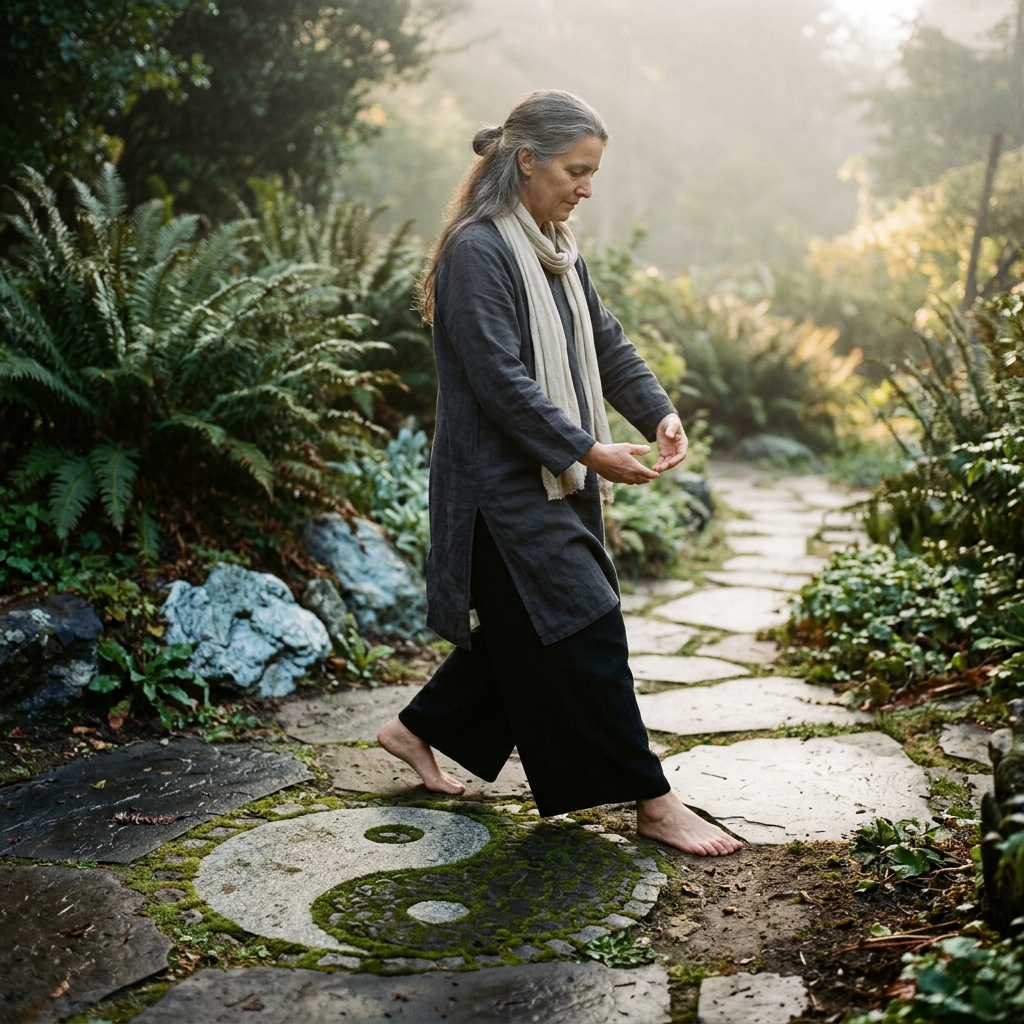
Pip: Which is where Tai Chi enters — not as a detour, but as a structural argument. Ancient meditative movement practices, the post says, integrate the brain’s hemispheres and re-pattern the neurological system toward emotional regulation. The body is part of the solution.
Mara: The post profiles Professor Cheng Man Ching, who brought Tai Chi to the West against the explicit orders of his masters. He once said he was approximately seventy percent Confucius and thirty percent Lao Tzu, and that learning how to be human takes a very long time.
Pip: Seventy-thirty is a surprisingly precise self-assessment for someone also teaching surrender.
Mara: The post also weaves in bibliotherapy — a medium using reading, film, podcasts, and other materials to support therapeutic change, especially between sessions. It traces back to an independent study in college exploring how clients get unstuck outside the therapy room.
Pip: That thread runs all the way to Pema Chodron, whose work the post closes with — a veteran Buddhist teacher the post credits as a leading force in bringing these principles to Western audiences.
Mara: The throughline is consistent: whether it’s Tai Chi, bibliotherapy, or sitting meditation, the practice is always about carrying the insight off the cushion and into ordinary life.
Pip: Stuckness, it turns out, is less a destination than a habit — and habits, given enough momentum, can be re-patterned.
Mara: Surrender as a technology for change — that’s the real thread running through all of this.
Pip: Next time, we’ll see what else the mothership has on the curriculum. There’s always more to unpack.
Please enjoy the original post that inspired this podcast at the link below:
A glowing full moon rises over a peaceful countryside at dusk
Check out this newly created experimental AI Podcast feature that aligns with my writing, compliments of WordPress.
Full Disclosure: Truly, I do take pride in my writing, and have yet to use AI for the written word. However, I have been having fun with playing around with AI for illustrations.
This podcast version of 1 of my more recent writings stars 2 AI created characters named Pip and Mara.
Please enjoy the podcast & transcript below:
Pip: Gemini season, a solstice, a strawberry moon, Mercury going sideways — June is apparently doing a lot.
Mara: This episode covers one post from Ari Joshua Bouse, mapping the celestial events of late June and what they invite us to pay attention to — new moons, seasonal turning points, a full moon with Indigenous roots, and a retrograde worth taking seriously.
Pip: Let’s start with the sky.
A New Moon in Gemini Through Mercury Retrograde
Mara: June opens with a New Moon in Gemini on the fifteenth, and the question this post is really asking is: what does the sky this month want from us, and how do we work with it rather than against it?
Pip: The post frames the Gemini New Moon as a prompt to balance thinking and feeling — and it puts it plainly: “Harmonizing with our heads and hearts helps support effective communication.”
Mara: That’s the throughline for the whole month. The New Moon opens a window for setting intentions, connecting socially, and letting communication projects move more freely. The post specifically names storytelling and sharing topical truths as things that can come to life with greater ease right now.
Pip: Then June 21 arrives carrying two things at once — the Summer Solstice and Father’s Day, a pairing that won’t repeat until 2037.
Mara: The post draws a real contrast there. In the Northern Hemisphere, the solstice carries what it calls Grandfather Sun-Yang energy — outward, expansive, growth-oriented. In the Southern Hemisphere, it’s the opposite: the longest night, Grandmother Moon-Yin energy, a turning inward.
Pip: The planet literally experiencing opposite seasons at the same moment — that’s the kind of thing that makes the phrase “duality of living on this planet” feel less like a bumper sticker.
Mara: The Full Strawberry Moon follows on June 29. The post traces that name to the Algonquin and other North American nations who connected the wild berry harvest to this moon, and notes that other cultures named it for whatever mattered most to people on the land at midsummer.
Pip: History embedded in a calendar. That’s not nothing.
Mara: June 21 also opens Cancer season, running through July 22. The post frames Cancer as a softer emotional register — nourishment, self-care, reconnecting with feeling. Then Mercury stations retrograde on June 29, lasting through July 23, and the post treats that as a genuine invitation: slow down, reflect, and pay attention to subconscious patterns.
Pip: So the month ends with two overlapping energies asking for the same thing — quiet and inward attention.
Mara: And the psychic and dream life, the post says, can surface real insight during that window if you’re working with it intentionally rather than just waiting for it to pass.
Pip: Which points straight toward how we actually tend our inner lives day to day.
Mara: A month of thresholds — new beginnings, a solstice, ancestral moons, a retrograde. The invitation seems to be: meet each one with some awareness.
Pip: More sky ahead. We’ll see what it asks for next time.
Please enjoy the original post that inspired this new podcast version at the link below:
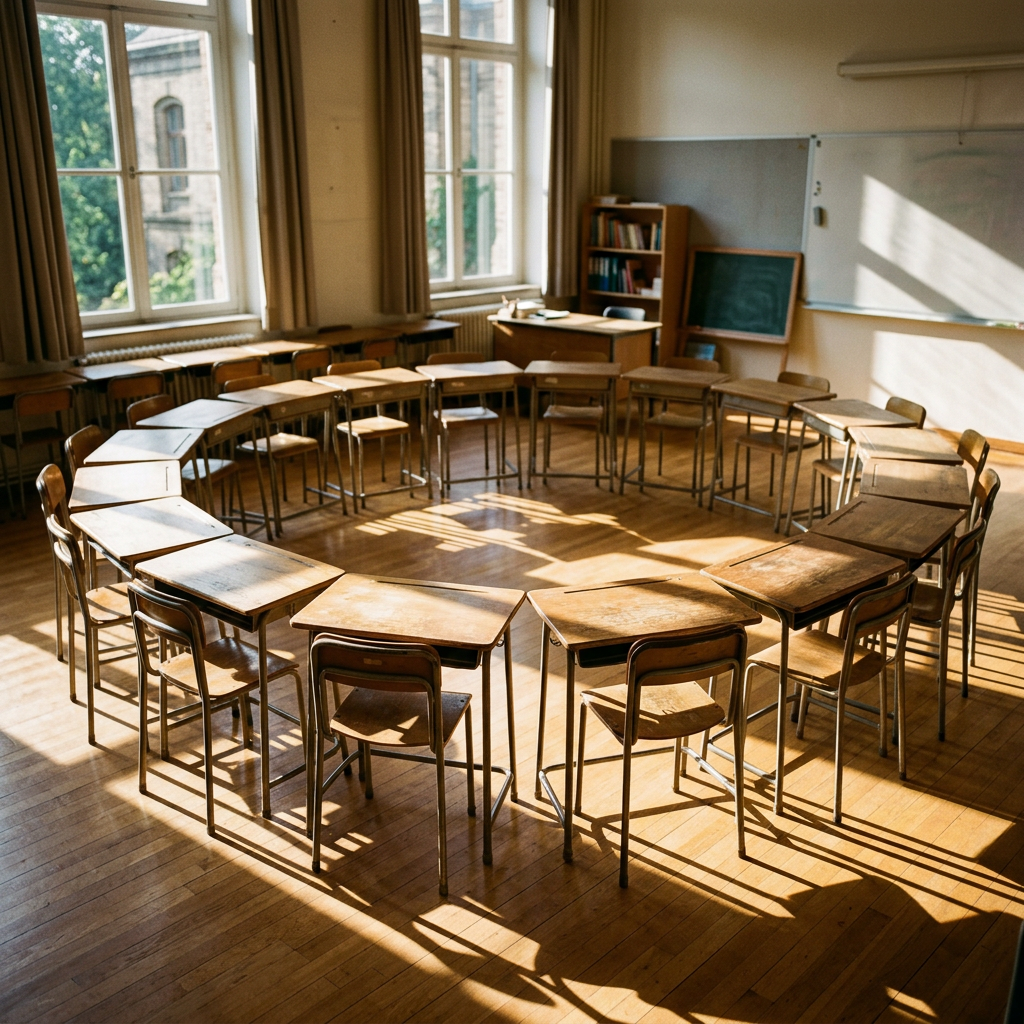
An empty classroom with wooden desks arranged in a circular formation bathed in sunlight.
Check out this newly created experimental AI Podcast feature that aligns with my writing, compliments of WordPress.
Full Disclosure: Truly, I do take pride in my writing, and have yet to use AI for the written word. However, I have been having fun with playing around with AI for illustrations.
This podcast version of 1 of my more recent writings stars 2 AI created characters named Pip and Mara.
Please enjoy the podcast & transcript below:
Pip: There’s a site called Classroom Mothership Earth, which is either a philosophy blog or the most ambitious field trip ever conceived — possibly both.
Mara: Ari Joshua Bouse writes here about education, consciousness, and the ideas that stay with you long after the bell rings. Today we’re following him back into a high school classroom and into Plato’s cave. Let’s start with what that cave actually meant.
Plato’s Allegory Of The Cave
Pip: The post opens with a prompt — describe something you learned in high school — and the answer isn’t a formula or a date. It’s a philosophy class that apparently rewired the writer’s entire sense of reality.
Mara: The Humanities course had a teacher who, as the post puts it, “embodied his humanity” — theatrical, philosophical, running the room like a group rather than a lecture. The layout shifted between rows, clusters, and horseshoe configurations to keep energy moving through the space.
Pip: So the room itself was part of the pedagogy. The furniture arrangement wasn’t aesthetic — it was functional, designed to open something up in the students.
Mara: And what got opened up, specifically, was Plato’s Allegory of the Cave. The post describes it this way: “the metaphor of humanity being asleep and trapped in own own darkness lit a fire in my neurons and energy field.”
Pip: That’s a sentence doing a lot of heavy lifting across several centuries of philosophy.
Mara: What it means in practice is that the allegory didn’t stay abstract. It landed as a personal reckoning — the post connects it directly to protective instincts, survival dynamics, and what it calls “death and rebirth” taking root in the psyche. This wasn’t intellectual exercise; it was identity-level disruption.
Mara: The class also covered Plato’s Republic against Pericles’ Democracy, the teacher’s own Theory of Good, and Herman Hesse’s Siddhartha. The curriculum was genuinely wide.
Pip: And the post notes that metacognition and superconsciousness weren’t yet common language — but that didn’t stop anyone from having those experiences. The concepts came later; the experiences came first.
Mara: The image that closes the reflection is the teacher drawing a diagram of the Cave on a blackboard, and the writer connecting that chalk sketch to ancient cave art. The visual form of the idea outlasted the lesson itself.
Pip: Turns out the cave has good acoustics for anything that echoes.
Mara: The throughline is that a single classroom encounter with one allegory can reorganize how a person understands consciousness — and keeps doing so long after graduation.
Pip: Shadows on a wall, seating arrangements, a teacher with chalk — small things that turn out to be load-bearing.
Mara: Next time, more from the mothership.
Please enjoy the original post that inspired this new podcast version at the link below:
Swirling water streams intertwine with glowing geometric crystals in an abstract composition.
Check out this newly created experimental AI Podcast feature that aligns with my writing, compliments of WordPress.
Full Disclosure: Truly, I do take pride in my writing, and have yet to use AI for the written word. However, I have been having fun with playing around with AI for illustrations.
This podcast version of 1 of my more recent writings stars 2 AI created characters named Pip and Mara.
Please enjoy the podcast & transcript below:
Pip: Classroom Mothership Earth — where the curriculum includes falling off your bike, losing on purpose, and calling all of it wisdom.
Mara: That’s actually a fair summary. Ari Joshua Bouse has a new post up exploring resilience, paradox, and how everyday stumbles become the practice itself. Let’s start with what it means to stop fighting the dark and work with it instead.
Embodying Paradox, Change and Humor In Everyday Life
Mara: The central question here is how resilience actually gets built — not by avoiding difficulty, but by changing your relationship to it. The post argues that resilience is cultivated, not inherited, and that the everyday moment is where that cultivation happens.
Pip: And the frame for all of it comes from a Taoist concept the post calls Investing In Loss. The setup is direct: “you might lose a game 99 times out of a hundred. But if you lose 99 times and you are paying mindful attention about your partners moves, you can learn their tricks, and spring the trap to win the 100th game.”
Mara: So the upshot is that losing, done consciously, is actually data. The mindset shift the post is pointing at is the difference between defeat and apprenticeship — same outcome, completely different relationship to it.
Pip: The bike and the swimming pool make the same case more viscerally. Most of us got water up our nose and fell off the handlebars and somehow did not develop lasting trauma from either. We just got back on.
Mara: Right — and the post uses that to ask a genuine question: how do we stay present in everyday life the way we were present when we were learning something genuinely new and a little scary? That’s where Dan Millman enters. The Way of the Peaceful Warrior gets name-checked as a long-running personal touchstone — a book recommended in high school, not fully read until after college, but never forgotten.
Pip: There is something quietly honest about admitting the book sat on the to-do list for years before it landed. Delayed absorption counts.
Mara: The post opens with two epigraphs that frame the whole thing. Eckhart Tolle on bringing in light rather than fighting darkness, and S. Kelley Harrell going further: “bless the darkness, hold the light, because the two aren’t divisible.” That’s the paradox the title is naming — not resolving the tension, but inhabiting it.
Mara: The shadow-boxing image the post offers — awakening to shades of your hidden self in a mirror — suggests the inner work and the outer stumbling are the same practice, just different angles.
Pip: Lose on purpose, get back on the bike, and hold the light and the dark at the same time. Straightforward advice, if you don’t mind the bruises.
Mara: That tension between difficulty and openness seems like the thread worth pulling next time.
Please enjoy the original post that inspired this new podcast version at the link below:
May all Beings be free of suffering, and awaken to God Consciousness, Cosmic Consciousness, Unity Consciousness, Diversity Within Unity, Inner Peace and the Universal Pillars of Love And Truth.
Complex network of glowing interconnected lines representing neural connections
Check out this newly created experimental AI Podcast feature that aligns with my writing, compliments of WordPress.
Full Disclosure: Truly, I do take pride in my writing, and have yet to use AI for the written word. However, I have been having fun with playing around with AI for illustrations.
This podcast version of 1 of my more recent writings stars 2 AI created characters named Pip and Mara.
Please enjoy the podcast & transcript below:
Pip: Mercury is in retrograde, paradigms are shifting, and somewhere a crocus is bravely breaching the frost — welcome to Classroom Mothership Earth.
Mara: This episode follows Ari Joshua Bouse into questions about consciousness, imagination, and what it actually means to navigate a world in transition. Let’s start with the post that frames all of it — what’s in this for any of us.
What’s In It For Me? A New World If You Can Take It.
Pip: The post opens with a provocation: we are collectively in transition, between paradigms, and the question is how you hold yourself together while the scenery changes around you.
Mara: The grounding line comes from Amit Goswami, who the post cites as arguing that consciousness is “the foundation of existence that causes the wave function to collapse into a single experienced reality.”
Pip: Which is a dense way of saying that what you believe about reality shapes the reality you experience — and that science and spirituality are, as the post puts it, converging in waves.
Mara: The post builds that convergence from several directions. Indigenous oral traditions — the Hopi origin story gets a specific nod — carry accounts of Sky People and humanity’s relationship with Mother Earth that predate modern frameworks by millennia.
Pip: And then there are the credentialed dissenters: Colonel Phillip J. Corso, author of The Day After Roswell, and Harvard psychiatrist John E. Mack, who wrote Passport to the Cosmos. Both decorated, both professionally established long before they started talking publicly about UFO and ET phenomena.
Mara: The post treats them as contextual witnesses — people whose prior credibility makes their later accounts harder to dismiss. The through-line is that stories about where we come from are not fixed. They shift the way seasons do.
Pip: The Mercury retrograde framing earns its keep here. The post compares it to The Twilight Zone — that liminal, slightly disorienting space where the usual rules feel suspended and perception gets elastic.
Mara: And the practical counsel the post lands on is this: stay playful, stay light-hearted, maintain a healthy detachment. The warning is against fixed thinking and fear-based framing — what the post calls “doomsday scenarios” and “war-mongering mentality.”
Pip: Einstein opens the whole thing — imagination over knowledge — and by the end you understand why. Knowledge consolidates what already exists. Imagination is what gets you through a paradigm shift without calcifying.
Mara: The post closes with a reminder that we may not control what happens, but we do choose our attitudes. Spring is arriving, crocuses are coming up, and the work is staying open to what’s next.
Pip: Consciousness as foundation, imagination as the tool, and a crocus as the unlikely mascot of paradigm change.
Mara: The territory here keeps expanding — next time, more from the edges of what we think we know.
Please enjoy the original post that inspired this podcast version at the link below:
Enjoy these recent podcast versions of Classroom Mothership Earth material below. Specifically, Overcoming Old Ghosts, Mindful Moments & Awakening To The Spirit Of Inner Peace and Remembering Grandmother’s Spirit were recently published articles in Edge of Humanity online magazine, as well as the powerful Mirror of the Mind Meditation, which you can also see on a video recording, as well as other mixed meditation demonstrations that are featured here on classroommothershipearth.com & https://classroommothershipearth.com/meditation/