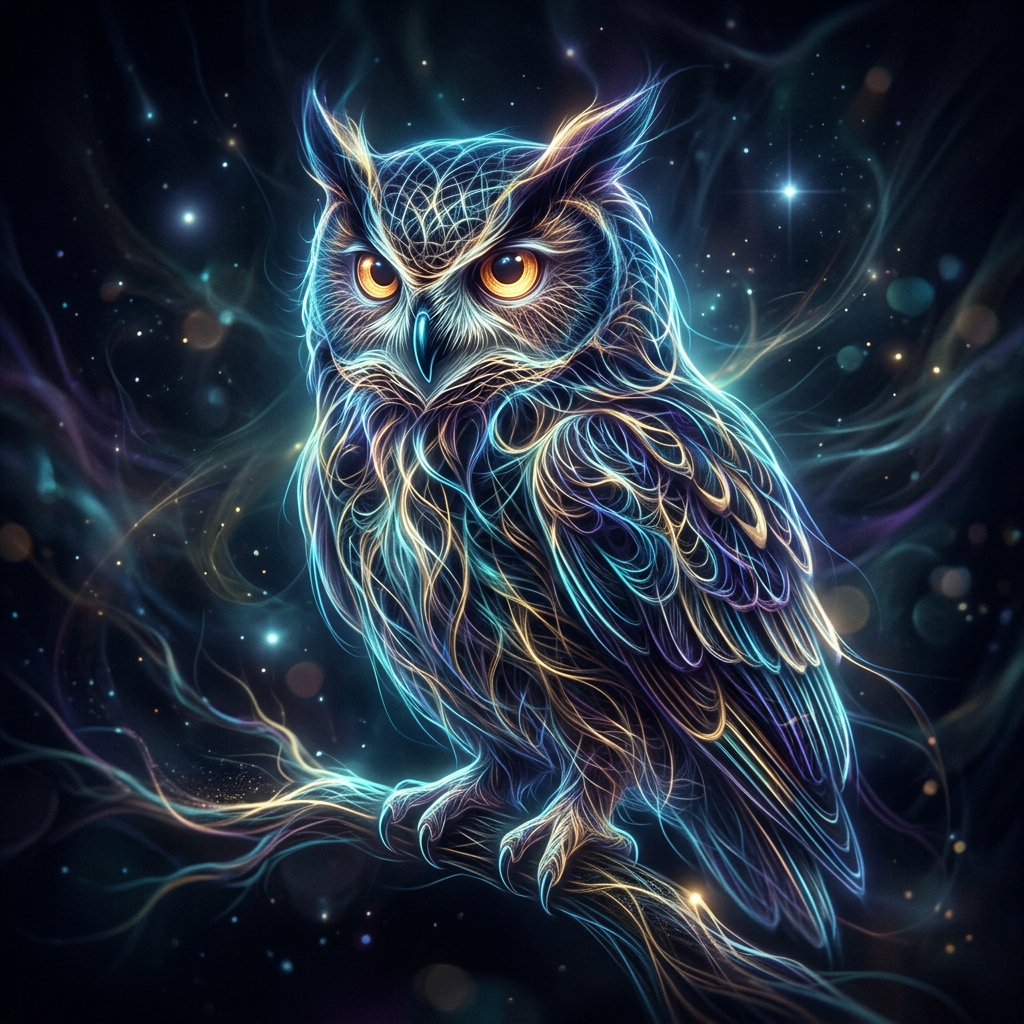
Pip: Classroom Mothership Earth — where the owl is always watching, the solstice is always coming, and the political metaphors are never quite finished with you.
Mara: Ari Joshua Bouse brings us into that territory today — spirituality, seasonal transition, and the harder questions about power, information, and what we choose to see in the dark. Let’s start with the owl.
Peering Into Our Spirituality With Owl
Pip: The frame here is the approaching Winter Solstice — the darkest day on the calendar — and the question of what that darkness asks of us spiritually, personally, and politically.
Mara: The post opens with exactly that lens: “Owl peers into dark nights with the light of empathic vision” — and from there it tracks what that vision might illuminate as the year contracts toward its lowest light.
Pip: So the owl isn’t decoration. It’s a way of asking what we can see precisely because we’re willing to look into uncomfortable places — grief, loss, the parts of ourselves that are waning along with the season.
Mara: That personal register runs through the whole piece. There’s a line about saying goodbye to old selves, to loved ones who have passed, to the ghosts of yesteryear — and then a pivot: “Remember a rainbow’s arrival reflects color back onto your soul.”
Pip: The grief gets company. That’s the move.
Mara: And then the post widens the lens considerably — out to the political, to questions about JFK declassification, to what gets suppressed in the name of national security, and whether the spirit of “We the People” is structurally in tension with protecting what the post calls “the minority of the opulent.”
Pip: The owl, it turns out, has opinions about the Military-Industrial Complex. Fair enough — so did a lot of owls in 1963.
Mara: The post holds those threads together by treating them as the same problem: a seductive mindset that believes people are inherently bad and need to be controlled. The prescription is “openness, trust and an authentically heartfelt solution-focused perspective” — and the warning is that apocalyptic thinking, once it’s target-marketed, becomes a self-fulfilling prophecy.
Pip: Which is a genuinely sharp observation. The machinery that profits from fear needs the fear to stay legible and renewable.
Mara: The post asks directly whether exposing establishment suppression is principle or narcissism — and leaves that question open, which feels honest.
Pip: Darkness, vision, what we’re willing to name — that’s the whole season, really.
Mara: Empathic vision as a practice — that’s what ties the personal grief and the political questions together here.
Pip: The owl keeps watch. We’ll see what it spots next time.
 Classroom Mothership Earth