Podcast Episode: New Published Material Revisited

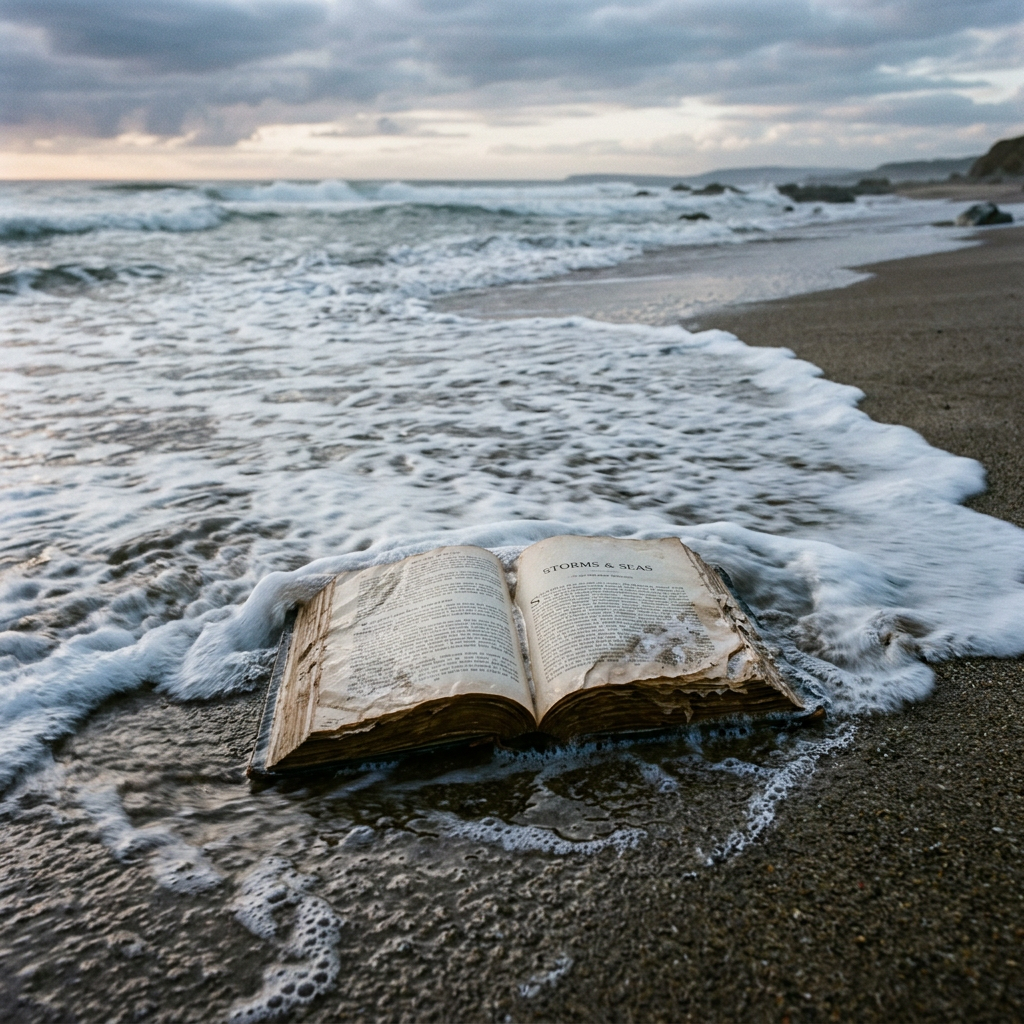
Open weathered book titled 'Storms & Seas' on wet sand with waves washing over it
An old, worn book is partially submerged as ocean waves wash over it on a beach.

Hi Folks! Mercury in Retrograde goes back direct today. As my wise old spiritual counselor Leo would say, keep in mind that the mental fog tends to lift & clear up over the next 10 days or so. Also, be patient with left brain cognition & machines as they come back online during this time. In the meantime, please enjoy this new AI 2 person podcast as an appetizer for my newest book:

Ladies and Gentlemen…Introducing AI Podcast Characters Pip & Mara On Ari’s Multimedia Writing:

Pip: Climate grief, ancestral memory, and the kind of soul wounds that don’t show up on an X-ray — Classroom Mothership Earth is not pulling punches this week.

Mara: Ari Joshua Bouse has been publishing through Edge of Humanity Magazine, and the work lands squarely on climate change, trauma, and what we carry from those who came before us. Let’s start with the new published material and what it’s actually doing.

New Published Material

Pip: The through-line across these pieces is a question worth sitting with: what does climate change cost us emotionally, spiritually, and across generations — not just ecologically?

Mara: The series is titled “A Novel Read into the New Shorelines of Climate Change,” and the post announces it plainly: “Please see my newly published writings via Edge of Humanity Magazine.”

Pip: That framing — new shorelines — does real work. Shorelines shift. They don’t vanish cleanly; they encroach. Using that as a metaphor for what climate change does to inner life as much as coastline is a choice worth noticing.

Mara: The series spans three distinct pieces. The first is a poem called “Overcoming Deep Traumatic Soul Wounds” — which puts psychological injury right alongside environmental upheaval, treating them as the same conversation.

Pip: Which they arguably are. The literature on climate grief has been making exactly that case for a decade, and here it’s arriving as verse rather than a journal abstract.

Mara: The second piece, “Weathering Changing Weather Patterns,” shifts register slightly — the title itself is doing double duty, the literal and the internal sitting on top of each other. And the third, “Remembering Our Ancestors,” is another poem, this one pulling the lens back to lineage and what prior generations understood about living with a changing earth.

Pip: So you have trauma, adaptation, and ancestral knowledge — three movements that together make something closer to a full emotional map of the climate moment than any single essay could.

Mara: All three sit inside a larger project that Edge of Humanity Magazine is running under that “New Shorelines” banner, which suggests this isn’t a one-off but an ongoing body of work finding its public form.

Pip: Poetry as climate literature — not the most obvious delivery mechanism, but possibly the most honest one.


Mara: The shoreline metaphor keeps expanding the more you sit with it — what’s eroding, what’s being redrawn, what we’re trying to hold onto.

Pip: Next time, more from the edge. Worth watching where those shorelines move.

Please enjoy the previously published poetry excerpts from my latest book at the link below:
Podcast Episode: Peering Into Our Spirituality With Owl Revisited

Neon-style glowing owl perched on a branch surrounded by stars
A luminous owl perched on a branch glowing with neon-like lines against a starry background.

Pip: Classroom Mothership Earth — where the owl is always watching, the solstice is always coming, and the political metaphors are never quite finished with you.

Mara: Ari Joshua Bouse brings us into that territory today — spirituality, seasonal transition, and the harder questions about power, information, and what we choose to see in the dark. Let’s start with the owl.

Peering Into Our Spirituality With Owl

Pip: The frame here is the approaching Winter Solstice — the darkest day on the calendar — and the question of what that darkness asks of us spiritually, personally, and politically.

Mara: The post opens with exactly that lens: “Owl peers into dark nights with the light of empathic vision” — and from there it tracks what that vision might illuminate as the year contracts toward its lowest light.

Pip: So the owl isn’t decoration. It’s a way of asking what we can see precisely because we’re willing to look into uncomfortable places — grief, loss, the parts of ourselves that are waning along with the season.

Mara: That personal register runs through the whole piece. There’s a line about saying goodbye to old selves, to loved ones who have passed, to the ghosts of yesteryear — and then a pivot: “Remember a rainbow’s arrival reflects color back onto your soul.”

Pip: The grief gets company. That’s the move.

Mara: And then the post widens the lens considerably — out to the political, to questions about JFK declassification, to what gets suppressed in the name of national security, and whether the spirit of “We the People” is structurally in tension with protecting what the post calls “the minority of the opulent.”

Pip: The owl, it turns out, has opinions about the Military-Industrial Complex. Fair enough — so did a lot of owls in 1963.

Mara: The post holds those threads together by treating them as the same problem: a seductive mindset that believes people are inherently bad and need to be controlled. The prescription is “openness, trust and an authentically heartfelt solution-focused perspective” — and the warning is that apocalyptic thinking, once it’s target-marketed, becomes a self-fulfilling prophecy.

Pip: Which is a genuinely sharp observation. The machinery that profits from fear needs the fear to stay legible and renewable.

Mara: The post asks directly whether exposing establishment suppression is principle or narcissism — and leaves that question open, which feels honest.

Pip: Darkness, vision, what we’re willing to name — that’s the whole season, really.


Mara: Empathic vision as a practice — that’s what ties the personal grief and the political questions together here.

Pip: The owl keeps watch. We’ll see what it spots next time.

Podcast Episode: Recognition Poem

Classroom with students and teacher, Earth and space background blending with room
Students engage in a science lesson with Earth and space visuals surrounding them.

Pip: Classroom Mothership Earth — where the self-help mantra, the bumper sticker, and the geopolitical aside share a page without anyone blinking.

Mara: Today we’re looking at work from Ari Joshua Bouse — specifically a poem that moves from inner recognition and self-talk all the way out to questions of disclosure, technology, and what we owe each other.

Pip: Let’s start with the poem itself — and what it means to truly recognize yourself.

Recognition Poem

Mara: The post opens with a premise about self-perception: that recognition — of yourself and of others — is the starting point, and that self-criticism quietly erodes the ground you stand on.

Pip: The poem names fear as the specific mechanism. Here’s the line that anchors it: “Fear of consequence avoids taking responsibility.”

Mara: That’s the hinge the whole piece turns on. If fear of what follows keeps you from owning what you’ve done, you’re not just stuck — you’re actively building the wall higher.

Pip: And the poem doesn’t let the outside world off the hook either. It moves from inner work outward — through what it calls cognitive distortions, through “Us and Them segregations,” through the idea that karmic consequences exist even when they go unseen and unheard.

Mara: There’s a line that earns its place quietly: “A Higher quality of respect comes from feeling safe to learn, even through peaceful and non-violent forms of tough love.” That’s the connective tissue between the personal and the communal — safety as a precondition for growth.

Pip: The poem then takes a hard turn into territory you don’t usually find between a self-talk mantra and a Latin etymology lesson — and yes, it notes that discipline traces back to the Latin root for teaching, which reframes the whole concept.

Mara: The outer section addresses technology, fossil fuels, and what it calls Full Disclosure — the idea that taxpayers hold a sovereign right to know how their money works. The bumper sticker image is the vehicle: imagine the Air Force holding a bake sale, and then imagine further until there’s nothing left to fund.

Pip: It’s a rhetorical escalation — start with the absurd image, then keep walking until the absurdity becomes the point.

Mara: The closing lines bring it back: “the spotlight of heart-centered mindfulness lays the cards on the table to call out the bluff.” Awareness, the poem argues, is itself a form of accountability.

Pip: Recognition as the first act of honesty — toward yourself, toward others, toward the systems you live inside.


Mara: The thread running through all of this is that seeing clearly — yourself, your fear, your world — is where any real change begins.

Pip: Next time, we’ll see what else comes into focus.

Podcast Episode: Letting Go Of Getting Stuck In Life By Being Present With Our Stuckness

Woman practicing Tai Chi barefoot on stone path with yin-yang symbol in garden

Check out this newly created experimental AI Podcast feature that aligns with my writing, compliments of WordPress.

Full Disclosure: Truly, I do take pride in my writing, and have yet to use AI for the written word. However, I have been having fun with playing around with AI for illustrations.

This version of 1 of my more recent writings stars 2 AI created characters named Pip and Mara.

Please enjoy the podcast & transcript below:

Pip: Classroom Mothership Earth — where getting unstuck, staying present, and surrendering to the universe are all on the syllabus, and somehow the homework is actually worth doing.

Mara: Today we’re covering work from Ari Joshua Bouse — one extended meditation on what it means to stop fighting your own stuckness and find your way back to the present moment. Let’s start with the heart of it: surrender as a path through.

Letting Go: Presence, Surrender, and Getting Unstuck

Mara: The central question here is deceptively simple — why do we get stuck, and what does it actually mean to let go? Not as a motivational slogan, but as a lived, embodied practice.

Pip: The post opens with a Rhonda Byrne line that stops you cold: “You can’t feel good when you’re feeling bad about feeling bad.”

Mara: That’s the trap in one sentence. The secondary suffering — the judgment layered on top of the original feeling — is often what keeps people frozen far longer than the feeling itself would.

Pip: And the post gets specific about what that looks like in practice. The reflection on getting stuck on other people’s stuckness, and taking it personally, is one of the more honest things you’ll read about how entanglement actually works.

Mara: The post frames it plainly: “experience teaches that it is freeing to stay centered, and observe those entanglements soften and relax.” Letting go of victim consciousness is described as a process — peeling away layers of an onion, not a single decision.

Pip: Which is where Tai Chi enters — not as a detour, but as a structural argument. Ancient meditative movement practices, the post says, integrate the brain’s hemispheres and re-pattern the neurological system toward emotional regulation. The body is part of the solution.

Mara: The post profiles Professor Cheng Man Ching, who brought Tai Chi to the West against the explicit orders of his masters. He once said he was approximately seventy percent Confucius and thirty percent Lao Tzu, and that learning how to be human takes a very long time.

Pip: Seventy-thirty is a surprisingly precise self-assessment for someone also teaching surrender.

Mara: The post also weaves in bibliotherapy — a medium using reading, film, podcasts, and other materials to support therapeutic change, especially between sessions. It traces back to an independent study in college exploring how clients get unstuck outside the therapy room.

Pip: That thread runs all the way to Pema Chodron, whose work the post closes with — a veteran Buddhist teacher the post credits as a leading force in bringing these principles to Western audiences.

Mara: The throughline is consistent: whether it’s Tai Chi, bibliotherapy, or sitting meditation, the practice is always about carrying the insight off the cushion and into ordinary life.

Pip: Stuckness, it turns out, is less a destination than a habit — and habits, given enough momentum, can be re-patterned.


Mara: Surrender as a technology for change — that’s the real thread running through all of this.

Pip: Next time, we’ll see what else the mothership has on the curriculum. There’s always more to unpack.

Please enjoy the original post that inspired this podcast at the link below:

Take care of yourselves everyone,

Ari

Podcast Episode: A Crazy Business Idea For Co-creating A Beautiful New World

Child standing in a futuristic classroom looking at Earth through large space station windows
A student gazes out at Earth from a high-tech space classroom

Check out this newly created experimental AI Podcast feature that aligns with my writing, compliments of WordPress.

Full Disclosure: Truly, I do take pride in my writing, and have yet to use AI for the written word. However, I have been having fun with playing around with AI for illustrations.

This podcast version of 1 of my more recent writings stars 2 AI created characters named Pip and Mara.

Please enjoy the podcast & transcript below:

Pip: Classroom Mothership Earth — where the daily writing prompt is “come up with a crazy business idea” and the answer turns out to be: civilization, but better.

Mara: Ari Joshua Bouse takes that prompt seriously, and today we’re following the thread — from a vision of shared consciousness and cooperative economics to what it actually looks like to clear space, inside and out.

Pip: Let’s start with the business idea itself.

A Crazy Business Idea For Co-creating A Beautiful New World

Mara: The post opens with a genuine question: what does an economy look like when the underlying operating system shifts — when interconnection is the default, not the exception?

Pip: And the answer isn’t a product or a pitch deck. It’s a paradigm. The post lays out what falls away when people genuinely feel their connection to each other.

Mara: The list is specific: “the institutionalized isms, trashing the park, wars, violence, gang banging, organized crime, the so called legitimate maximum-economic profit capitalist conditioning, economic strangulations, and the need to control each other fades away, and is released into a black hole in the Universe.”

Pip: That’s a sentence doing a lot of heavy lifting — and the point underneath it is real. The argument is that these patterns aren’t permanent features of human nature; they’re symptoms of a particular kind of disconnection.

Mara: Right, and the post is careful to say it doesn’t get killed or die — it transforms. The balloon metaphor follows: letting go of a thought form so it floats away, rather than fighting it.

Pip: There’s a friend in the piece who’s been sober from the news for over a year and reports genuine levity — less charge around politics, less reactive energy. That’s offered as a small proof of concept.

Mara: The post connects that to The Celestine Prophecy — James Redfield’s intention, quoted directly, was to inspire readers to “reclaim their power from dominant authorities and dysfunctional relationships: not via political or legal action but through a personalized spirituality that portrays life as a meaningful journey toward self-actualization.”

Pip: So the crazy business idea is essentially: skip the legal filing, go straight to the consciousness upgrade.

Mara: The post also gets concrete about physical space — imagining trash compressed in a way that literally opens up room, turning what looked like a landfill into ground for new growth. It’s the same logic applied materially.

Pip: And the T’ai Chi section earns its place. Professor Cheng’s instruction to “be like a ghost” — to create spaciousness — maps directly onto the economic argument: lead, follow, listen, don’t force.

Mara: The upshot is that cooperative competition, in this frame, isn’t naive. It’s more like push hands than a zero-sum match — sensitive to the other’s energy, not trying to overpower it.

Pip: Which makes the closing meditation clip feel less like an appendix and more like the actual deliverable.

Mara: That thread — from inner clearing to outer structure — is what the whole piece is building toward.


Pip: Clear the space, transform the pattern, don’t fight the balloon — it’s a coherent through-line once you follow it.

Mara: More from Classroom Mothership Earth next time.

Please enjoy the original post that inspired this new podcast version at the link below:

Take care of yourselves everyone,

Ari

Podcast Episode: What’s In It For Me? A New World If You Can Take It.

Glowing interconnected lines forming a complex neural network structure
Complex network of glowing interconnected lines representing neural connections

Check out this newly created experimental AI Podcast feature that aligns with my writing, compliments of WordPress.

Full Disclosure: Truly, I do take pride in my writing, and have yet to use AI for the written word. However, I have been having fun with playing around with AI for illustrations.

This podcast version of 1 of my more recent writings stars 2 AI created characters named Pip and Mara.

Please enjoy the podcast & transcript below:

Pip: Mercury is in retrograde, paradigms are shifting, and somewhere a crocus is bravely breaching the frost — welcome to Classroom Mothership Earth.

Mara: This episode follows Ari Joshua Bouse into questions about consciousness, imagination, and what it actually means to navigate a world in transition. Let’s start with the post that frames all of it — what’s in this for any of us.

What’s In It For Me? A New World If You Can Take It.

Pip: The post opens with a provocation: we are collectively in transition, between paradigms, and the question is how you hold yourself together while the scenery changes around you.

Mara: The grounding line comes from Amit Goswami, who the post cites as arguing that consciousness is “the foundation of existence that causes the wave function to collapse into a single experienced reality.”

Pip: Which is a dense way of saying that what you believe about reality shapes the reality you experience — and that science and spirituality are, as the post puts it, converging in waves.

Mara: The post builds that convergence from several directions. Indigenous oral traditions — the Hopi origin story gets a specific nod — carry accounts of Sky People and humanity’s relationship with Mother Earth that predate modern frameworks by millennia.

Pip: And then there are the credentialed dissenters: Colonel Phillip J. Corso, author of The Day After Roswell, and Harvard psychiatrist John E. Mack, who wrote Passport to the Cosmos. Both decorated, both professionally established long before they started talking publicly about UFO and ET phenomena.

Mara: The post treats them as contextual witnesses — people whose prior credibility makes their later accounts harder to dismiss. The through-line is that stories about where we come from are not fixed. They shift the way seasons do.

Pip: The Mercury retrograde framing earns its keep here. The post compares it to The Twilight Zone — that liminal, slightly disorienting space where the usual rules feel suspended and perception gets elastic.

Mara: And the practical counsel the post lands on is this: stay playful, stay light-hearted, maintain a healthy detachment. The warning is against fixed thinking and fear-based framing — what the post calls “doomsday scenarios” and “war-mongering mentality.”

Pip: Einstein opens the whole thing — imagination over knowledge — and by the end you understand why. Knowledge consolidates what already exists. Imagination is what gets you through a paradigm shift without calcifying.

Mara: The post closes with a reminder that we may not control what happens, but we do choose our attitudes. Spring is arriving, crocuses are coming up, and the work is staying open to what’s next.


Pip: Consciousness as foundation, imagination as the tool, and a crocus as the unlikely mascot of paradigm change.

Mara: The territory here keeps expanding — next time, more from the edges of what we think we know.

Please enjoy the original post that inspired this podcast version at the link below:

Take care of yourselves everyone,

Ari

“What’s In It For Me? A New World If You Can Take It.”

“Imagination is more important than knowledge. For knowledge is limited, whereas imagination embraces the entire world, stimulating progress, giving birth to evolution.”

–Albert Einstein

Mercury in Retrograde (currently February 26th-March 20th) is often viewed as perceptually akin to the classic old TV series The Twilight Zone.

Growing up, I heard some of my family members talk about how they loved that show, and how they watched it faithfully at that time. By the time of was a teenager in the 80s, the old show was resurrected and reimagined into a new version with the same name. I enjoyed watching both versions.

Check out the brief opening sequence to the show below that illustrates the point:

Looking back on humanity’s origins, our Indigenous ancestors have passed down stories about the Sky People, their relationship with Mother Earth, and their influences on our evolution as a species.

Just as an example, check out the brief Hopi Origin Story clip below for contextual understanding:

And then some years later, just after I finished graduate school and began my career as a professional social worker, I read a couple of non-fiction books entitled, The Day After Roswell, by the late Colonel Phillip J. Corso, and Passport To The Cosmos, by the late Harvard Psychiatrist, John E. Mack. Both American men were Veterans, and highly respected within their professional fields, long before they started speaking out about UFO and ET phenomena.

Check out the interviews with them below to see for yourself what they had to say about their experiences. Consider how their stories provides further contextual understanding to our current developing narrative on this important topic:

Furthermore, respected scientists like, Amit Goswami, “argue that consciousness is the ‘foundation of existence’ that causes the wave function to collapse into a single experienced reality.”

From this perspective, the convergence of science and spirituality are coming in waves, if you’ll pardon the pun.

During its lifetime, this blog has explored consciousness and the reality of its mystery.

Stories about where we come from, our purpose here, and where we are going are not fixed states.

Rather, like seasons, our experiences are fluid and changing.

In much the same way as Spring and Fall are arriving (depending on where you are on the Planet), humanity is collectively in a transition between paradigms.

In this writer’s neck of the woods, birds are singing and you can see evidence of Spring happening. Days are getting lighter, crocuses are starting to breach, and warmer temperatures are starting to show up in the forecast. But Winter is still hanging around, and is quite adept at reminding humans about it; to the chagrin of the moods of many.

From a expanding soul consciousness perspective, the way the aforementioned material is playing out in the 3D realm is shifting.

As such, a growing body of us are seeing the world change before our eyes.

The trick is to not get seduced into any Doomsday scenarios or fear-based war mongering mentality.

Remember there is nothing more devilish than fixed mind, rigid thinking, or a hardened heart.

We may not always be able to control what happens to us.

But we do have the power to choose our attitudes.

Keep in kind mindfulness that a playful, light-hearted and healthy sense of detachment can go a long way to keep your wits about you…especially as we moved forward during the tumultuous times we are living in right now.

May all Beings be free from suffering, and know Inner Peace as an awakening State of Consciousness,

Ari

A Crazy Business Idea For Co-creating A Beautiful New World

Daily writing prompt
Come up with a crazy business idea.

Imagine a freethinking society where everyone meditates because it is a common core value that is built into a new systemic normal where energy is freely shared and exchanged. I know it sounds so Celestine Prophecy and all (not that there’s anything wrong with that).

But in this paradigm, we are operating from a liberated state of consciousness; where our Oneness and interconnection are regularly understood, and are self-evident in our day to day operations.

We will still differentiate and respect boundaries, but we do that without seeing ourselves or anything else for that matter as separate or disconnected. Different strokes, for different folks.

From this perspective, the institutionalized isms, trashing the park, wars, violence, gang banging, organized crime, the so called legitimate maximum-economic profit capitalist conditioning, economic strangulations, and the need to control each other fades away, and is released into a black hole in the Universe. It doesn’t get killed or die, it just transforms.

It’s like letting go of a balloon or blowing bubbles as a kid with positive self talk forms traveling within those thought forms as they float away into the depths of the Universe.

Reminds me of a longitudinal connective friend who recently told me he has been “sober from the news for over a year.” Even better to hear was that he was experiencing levity from unplugging, and commented that he doesn’t feel the charge he once did about others when discussing politics and other mistakes as portrayed on the news feeds. Funny, over two decades ago, the same friend told me he wanted to learn how to levitate. Ah, like a good folk song, psychic development can get the job done without the frills.

It’s hard to go wrong with peaceful, calming thoughts folks. And you can focus on them more when you are not seduced into the mainstream media behavioral trap.

Speaking of the aforementioned Jame’s Redfield’s classic book, and subsequent film, I really appreciate the author’s intention of The Celestine Prophecy to inspire readers to “reclaim their power from dominant authorities and dysfunctional relationships: not via political or legal action but through a personalized spirituality that portrays life as a meaningful journey toward self-actualization.”

Alas, the ego doesn’t understand this dimensional frequency vibration because it can’t control it. What?

Just as an example, we all know that we have created a lot of trash in the park. And we have produced more humans with more disposables. But even with waste management, imagine compressing the empty matter of trash in a way that literally opens up space.

Once the new space is cleared and opened, the possibilities are endless. What used to look like a dump, landfill, transfer station or recycling center is no longer taking up space that appears as an eyesore. You wouldn’t even know it’s there anymore because now the space has transformed into a garden variety of new forms that reveal new growth. This is yet another win-win solution that only looks crazy in an insane paradigm.

Without the need to make a profit off of destructive and dissasterous forces, a more playful and balanced form of cooperative competition takes place. It’s less like competing against each other where there’s winners and losers. It wasn’t till I was in my mid-20s till I heard the saying, if you had fun, then you won.

In much the same way as in T’ai Chi Push Hands, avoiding conflict and getting along with each other is more about knowing when to lead and when to follow by listening and being sensitive to each other’s energy. Just as an example, a verbal assault is met with non-resistance and knowing that standing in your personal authority means that it’s ok to walk away. But in this crazy business idea, there is no need for an assault of any kind because the deeply engrained and conditioned human patterns are blown away like the old Oklahoma Dust Bowl days. When teaching his beloved T’ai Chi classes, past students of Professor Cheng used to say that he would emphasize to “be like a ghost.” This is akin to the idea (and more importantly the perceptible experience) of emptying the mind, or creating spaciousness (a more accurate translation)… or like mindfulness or presence (a more accurate translation). Check out the brief silent clip below to get a feel for his demonstrations:

On a subatomic level, forms are paradoxically mostly empty and formless anyway. Of course we know that from a brain science perspective that most of what we see only includes a fraction of what’s really going on before our eyes.

There’s deep dive wisdom behind the truth that things will appear as they truly are when the doors of perception are cleansed.

In the Billy Carson meditation clip below, he has created a beautifully powerful meditation with relaxing music in the background. I feel that it captures and amplifies the sentiment. Please enjoy taking a closer look and allowing yourself to get into the spirit of this meditation:

Cat & Mouse Is What I Do

Daily writing prompt
Do you play in your daily life? What says “playtime” to you?

I remember when I embarked on an adventurous family reunion in Italy many years ago, and one of my cousins looked at me, and said, “Ari, is it fun in there?” She was referencing my mind, and made this comment after I cracked a barrage of puns, and other theatrical wit. Perhaps if my Italiano was better, then I could have disguised my cornball humor so that it would have read like a foreign language.

And then many moons later, I worked for a new School Principal who brought with her a book called Fish Philosophy into the school community we worked in together at the time. As our new administrator, she built in Fish Philosophy into our staff professional development to enact cultural norms encouraging us to “choose your attitude” and “make their day.”

The theme of Fish Philosophy is simple and was adopted from the famous fish market in Seattle, where the workers throw fish at each other, customers and have fun doing it. Imagine that . . . work and play going together, and that we have a choice in whether we do that or not in the school of life. Before I even read any of the book, a new coworker came up to me after a work related training, and made it a point to tell me that he had started reading the book, and said that I was a good role model of the book’s theme.

https://www.pikeplacefish.com/about

Since before I came out of the womb, I’m sure the cat and mouse part of my personality wasn’t part of my hidden self. As a boy, my mom said that I liked it when she read to me in the womb. Truly, I was probably already acting out the characters that she was reading to me. Most of the trouble I got into in school by teachers, and later in sports by coaches was my clowning around with people, and finding parody and jest in the everyday mundane encounters.

For example, one of my favorite coping strategies to introduce to kids (and adults) is the idea of imagining that the business of life is like playing a video game in your head. It’s been since I was in Middle School that I was a regular video game player, but when I came across that strategy, it resonated in me and many other students I worked with over the years. The Tai Chi classes I have taken also emphasized and embodied the idea of playing with form.

These days, most people expect to be entertained, and typically by someone or something else that they perceive to be outside of themselves; as in an external object of affection, like a pacifier. But the real trick is to discover ways to play with life. As other people take notice, it does tend to become contagious.

Just as an example, I like to play around with mindful breathing during a workout or exercise routine because it brings you into the present moment. Breathing mindfully also makes the workout or exercise routine feel less like work, exercise or a routine for that matter. And when I play my guitar, that’s all I’m doing is playing. It’s more fun that way.

Shooting The New Moon Into A New Chapter

Photo by Mikhail Nilov on Pexels.com

The only constant in life is change, aka the Law of Transience. May the energy of this New Moon in Sagittarius on Tuesday, December 12 be a friendly reminder that Nature reflects change.

Like the seasons, change is inevitable. Tastebuds change, relationships change, and even our DNA can change. But with change, there is a death of the old self; not without its grieving.

What makes Sagittarius so unique is its dynamic blend of passion, curiosity, intensity, and adaptability. The archer or a hybrid human/horse centaur, is symbolic of this sign.

Moreover, their energies aren’t afraid to use its bow and arrow to explore expansive terrain, seeking answers in places and spaces others wouldn’t dare venture.

Remember that even in the darkness of death, there is the rebirth of light. Truly, we grieve the loss of death energy. And yet at the same time; may we welcome the light born again unto our souls.

It is the last New Moon of 2023. Fitting this New Moon is associated with fiery and passionate energies.

Might as well be in alignment with these energies and go out with a bang, in peaceful and non-violent ways of course. Peaceful and non-violent strategies are more sustainable ways of conflict resolution and harmonizing with our environment.

Where are you at on your map of consciousness with regards to change? Are you resisting the changes of your old self? Or are you moving into a place of gratitude, letting go and even surrendering to the Universe’s signs and synchronicities to light your way? Are you allowing yourself to paint a creative picture in a New Chapter in the Mirror of the Mind?

Given our modern cultural narrative that conditions us to buy into holiday mania of rampant consumerism, artificial light, and being up all the time; it’s no wonder people get depressed about darker days and darker emotions. But darker days invite us to examine our darker thoughts, which are quite natural.

The real suffering is the clinging to and resistance of our thoughts and then the emotional reactions, judgements and stories thereof.

It can be freeing to simply watch out thoughts, and even go beyond our judgements into a dimensional shift of awareness.

Awareness, along with the the power of Universal energies right now can help you take action to create the New Chapter that you desire. It can be done with letting go of the old chapter with gratitude; so as to facilitate a healthy transition into the New Chapter with as much love as possible.

Moreover, the Sagittarius New Moon is a great time to focus on healing and bringing yourself into a state of balance. Use this New Moon to plant seeds of calm balance and think about what you want to manifest for the weeks ahead.

On the day after the New Moon, Mercury in Retrograde will happen on December 13th and stay till January 1, 2024. I saw a hawk do a flyover the other day, and it felt like a prequel to the chi of the forthcoming Mercury in Retrograde. In much the same way as Coyote’s vibe, Mercury in Retrograde can bring in trickster energy into the 3-D realm.

Beyond that, there is a higher vibration on a multidimensional level. For example, in mythology, Mercury is the Messenger of the Gods. Further, during its retrograde cycle, it can more quickly and easily bring these messages to us intuitively. This is a powerful time to focus on your intuitive and psychic gifts.

Pay mindful attention to your intuition and other subtler forms of communication like dreams, synchronicities, and perhaps consulting spiritual oracle decks under Mercury Retrograde. They will likely be sending you encouraging positive reinforcements for authentic living, if only we gently allow for them to build gradually, like the power of water.

A Full Cold Moon will happen the day after Christmas, on December 26th. This is the darkest Full Moon of the year because it always occurs around the Winter Solstice, the darkest day of the year in the Northern Hemisphere. The Winter Solstice will happen on December 21st. Like our ancestors that came before us, this is a good time to gather around a fire, honor the darkness, go deep into our soul caves and begin to coax back the light. After the Winter Solstice, our days will become a little longer. Paradoxically, it will be the opposite in the Southern Hemisphere; the Vernal Equinox will bring shorter days ahead. The Winter Solstice is a powerful time for expressing gratitude for what is and letting go of what was.

Take care of yourselves everyone,

Ari