Podcast Episode: Letting Go Of Getting Stuck In Life By Being Present With Our Stuckness

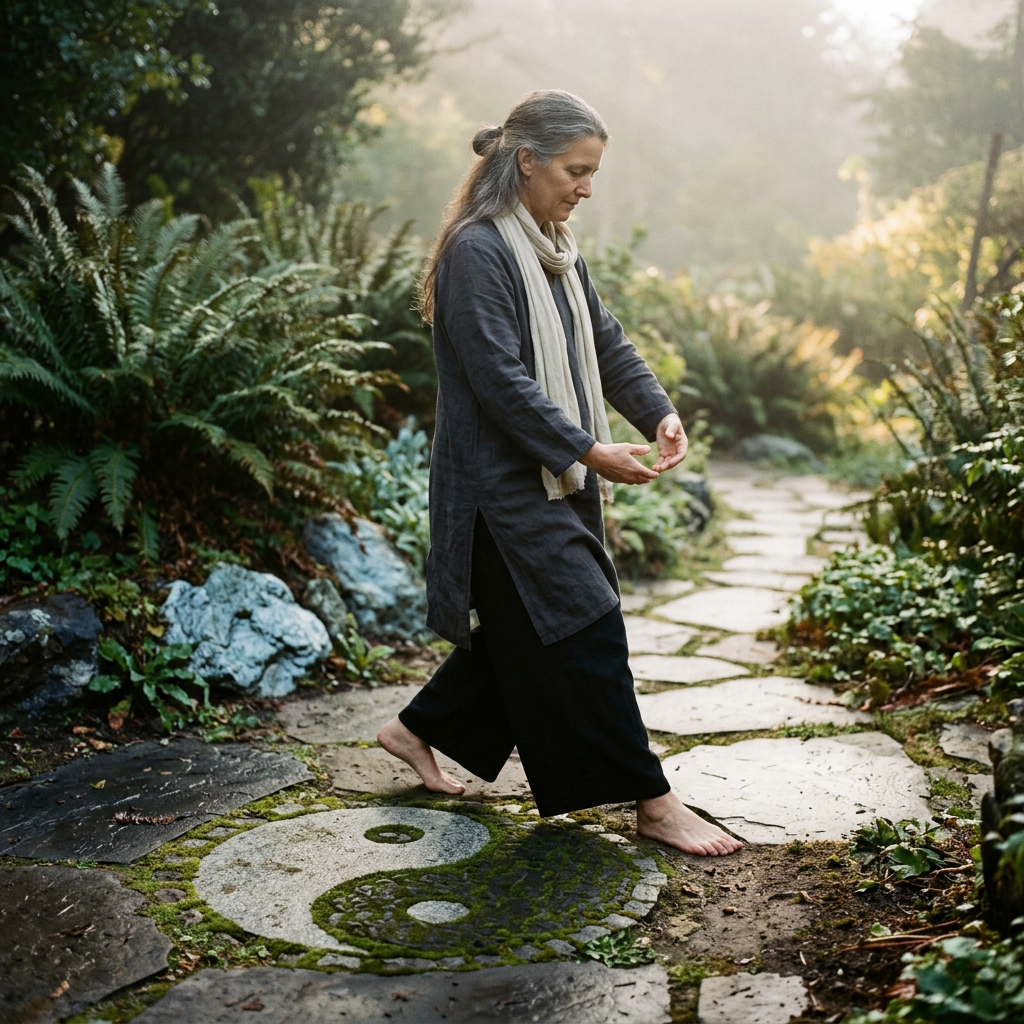
Woman practicing Tai Chi barefoot on stone path with yin-yang symbol in garden

Check out this newly created experimental AI Podcast feature that aligns with my writing, compliments of WordPress.

Full Disclosure: Truly, I do take pride in my writing, and have yet to use AI for the written word. However, I have been having fun with playing around with AI for illustrations.

This version of 1 of my more recent writings stars 2 AI created characters named Pip and Mara.

Please enjoy the podcast & transcript below:

Pip: Classroom Mothership Earth — where getting unstuck, staying present, and surrendering to the universe are all on the syllabus, and somehow the homework is actually worth doing.

Mara: Today we’re covering work from Ari Joshua Bouse — one extended meditation on what it means to stop fighting your own stuckness and find your way back to the present moment. Let’s start with the heart of it: surrender as a path through.

Letting Go: Presence, Surrender, and Getting Unstuck

Mara: The central question here is deceptively simple — why do we get stuck, and what does it actually mean to let go? Not as a motivational slogan, but as a lived, embodied practice.

Pip: The post opens with a Rhonda Byrne line that stops you cold: “You can’t feel good when you’re feeling bad about feeling bad.”

Mara: That’s the trap in one sentence. The secondary suffering — the judgment layered on top of the original feeling — is often what keeps people frozen far longer than the feeling itself would.

Pip: And the post gets specific about what that looks like in practice. The reflection on getting stuck on other people’s stuckness, and taking it personally, is one of the more honest things you’ll read about how entanglement actually works.

Mara: The post frames it plainly: “experience teaches that it is freeing to stay centered, and observe those entanglements soften and relax.” Letting go of victim consciousness is described as a process — peeling away layers of an onion, not a single decision.

Pip: Which is where Tai Chi enters — not as a detour, but as a structural argument. Ancient meditative movement practices, the post says, integrate the brain’s hemispheres and re-pattern the neurological system toward emotional regulation. The body is part of the solution.

Mara: The post profiles Professor Cheng Man Ching, who brought Tai Chi to the West against the explicit orders of his masters. He once said he was approximately seventy percent Confucius and thirty percent Lao Tzu, and that learning how to be human takes a very long time.

Pip: Seventy-thirty is a surprisingly precise self-assessment for someone also teaching surrender.

Mara: The post also weaves in bibliotherapy — a medium using reading, film, podcasts, and other materials to support therapeutic change, especially between sessions. It traces back to an independent study in college exploring how clients get unstuck outside the therapy room.

Pip: That thread runs all the way to Pema Chodron, whose work the post closes with — a veteran Buddhist teacher the post credits as a leading force in bringing these principles to Western audiences.

Mara: The throughline is consistent: whether it’s Tai Chi, bibliotherapy, or sitting meditation, the practice is always about carrying the insight off the cushion and into ordinary life.

Pip: Stuckness, it turns out, is less a destination than a habit — and habits, given enough momentum, can be re-patterned.


Mara: Surrender as a technology for change — that’s the real thread running through all of this.

Pip: Next time, we’ll see what else the mothership has on the curriculum. There’s always more to unpack.

Please enjoy the original post that inspired this podcast at the link below:

Take care of yourselves everyone,

Ari

Podcast Episode: A Crazy Business Idea For Co-creating A Beautiful New World

Child standing in a futuristic classroom looking at Earth through large space station windows
A student gazes out at Earth from a high-tech space classroom

Check out this newly created experimental AI Podcast feature that aligns with my writing, compliments of WordPress.

Full Disclosure: Truly, I do take pride in my writing, and have yet to use AI for the written word. However, I have been having fun with playing around with AI for illustrations.

This podcast version of 1 of my more recent writings stars 2 AI created characters named Pip and Mara.

Please enjoy the podcast & transcript below:

Pip: Classroom Mothership Earth — where the daily writing prompt is “come up with a crazy business idea” and the answer turns out to be: civilization, but better.

Mara: Ari Joshua Bouse takes that prompt seriously, and today we’re following the thread — from a vision of shared consciousness and cooperative economics to what it actually looks like to clear space, inside and out.

Pip: Let’s start with the business idea itself.

A Crazy Business Idea For Co-creating A Beautiful New World

Mara: The post opens with a genuine question: what does an economy look like when the underlying operating system shifts — when interconnection is the default, not the exception?

Pip: And the answer isn’t a product or a pitch deck. It’s a paradigm. The post lays out what falls away when people genuinely feel their connection to each other.

Mara: The list is specific: “the institutionalized isms, trashing the park, wars, violence, gang banging, organized crime, the so called legitimate maximum-economic profit capitalist conditioning, economic strangulations, and the need to control each other fades away, and is released into a black hole in the Universe.”

Pip: That’s a sentence doing a lot of heavy lifting — and the point underneath it is real. The argument is that these patterns aren’t permanent features of human nature; they’re symptoms of a particular kind of disconnection.

Mara: Right, and the post is careful to say it doesn’t get killed or die — it transforms. The balloon metaphor follows: letting go of a thought form so it floats away, rather than fighting it.

Pip: There’s a friend in the piece who’s been sober from the news for over a year and reports genuine levity — less charge around politics, less reactive energy. That’s offered as a small proof of concept.

Mara: The post connects that to The Celestine Prophecy — James Redfield’s intention, quoted directly, was to inspire readers to “reclaim their power from dominant authorities and dysfunctional relationships: not via political or legal action but through a personalized spirituality that portrays life as a meaningful journey toward self-actualization.”

Pip: So the crazy business idea is essentially: skip the legal filing, go straight to the consciousness upgrade.

Mara: The post also gets concrete about physical space — imagining trash compressed in a way that literally opens up room, turning what looked like a landfill into ground for new growth. It’s the same logic applied materially.

Pip: And the T’ai Chi section earns its place. Professor Cheng’s instruction to “be like a ghost” — to create spaciousness — maps directly onto the economic argument: lead, follow, listen, don’t force.

Mara: The upshot is that cooperative competition, in this frame, isn’t naive. It’s more like push hands than a zero-sum match — sensitive to the other’s energy, not trying to overpower it.

Pip: Which makes the closing meditation clip feel less like an appendix and more like the actual deliverable.

Mara: That thread — from inner clearing to outer structure — is what the whole piece is building toward.


Pip: Clear the space, transform the pattern, don’t fight the balloon — it’s a coherent through-line once you follow it.

Mara: More from Classroom Mothership Earth next time.

Please enjoy the original post that inspired this new podcast version at the link below:

Take care of yourselves everyone,

Ari
Letting Go Of Getting Stuck In Life By Being Present With Our Stuckness Through The Power Of A Sweet Surrender

-Rhonda Byrne

Looking back in the rearview mirror, I remember working with a spiritual counselor for many years, who reminded me that people get stuck in life, and can have a really hard time getting unstuck. His empathy statement still sounds true because, the truth is, we all get stuck.

Upon reflection, my old spiritual counselor’s wise guidance invited a personal awakening of an awareness that a big part of my own getting stuck at that time was that I was getting stuck on other people’s stuckness . . . and taking it personally. It can be hard to not to become moved by other people’s stuff. Although experience teaches that it is freeing to stay centered, and observe those entanglements soften and relax. Ah, letting go of victim consciousness is a process, like peeling away the layers of an onion.

Awakening to our true nature as spiritual beings having human experiences happens when we are surrendering to the will of the Universe by getting in alignment with it. Ancient meditative movement practices like Tai Chi supports this process by integrating the right and left hemispheres of our brains, and facilitating emotional regulation of our neurological systems by re-patterning them.

In addition to Bruce Lee’s beautiful introduction, the video below also features Professor Cheng Man Ching, who brought Tai Chi to the West, and some of his students who reflect back on their experiences with him. Both of these men had very strong rebellious streaks because they brought secrets of their people to the West. Sharing their knowledge with outsiders was strictly forbidden, and against the orders of their masters.

But they both knew that the West needed to be clued in to the mysteries of the martial arts. Although Professor’s students deeply respected him as a master, some have also said that he wasn’t an enlightened being, and that he had an ego. His playful soul and competitive spirit is probably what made him so approachable to his students. Not long before he died, he said that he was approximately 70% Confucius and 30% Lao Tzu. He also emphasized that he was interested in learning how to be human, and that it takes a long time to do that:

Reflecting back on my own experiences with getting stuck, and what to do about it reminds me of my last semester of college, many moons ago. At that time, I took an extra class as an independent study with one of my psychology professors so that I could graduate on time. Part of my stuckness back then was procrastination. It’s not that Grandmother’s Stop Procrastination tapes with subliminal message hidden underneath ocean waves didn’t work. It’s just that building ‘Righteous Chi’ works gradually, like the power of water. Once enough momentum is present, there is no stopping it.

Back to my last semester in college . . . I took a heavy course load to fulfill my academic requirements for graduation. My psychology professor was also a part time psychotherapist, who worked with a colleague who was also a therapist with his own full time practice. These two progressive men were both concerned about when their clients would get stuck during their therapeutic process, particularly between sessions. Part of their stuckness as psychotherapists was when their clients would get stuck. As therapists, they felt a degree of responsibility and helplessness about that.

Given that, both clinical psychologists were very interested in exploring a newly emerging therapeutic idea at the time called bibliotherapy. Basically, bibliotherapy is a medium to utilize reading, and other multimedia forms (movies, videos, podcasts, quotes, articles, etc.) to reinforce the power of the therapeutic process for change to occur. The independent study explored a deep dive into how bibliotherapy might be utilized as a medium to help clients get unstuck; especially during the interval between sessions or when they were outside of a therapy session. The three of us met weekly to discuss and unpack bibliotherapeutic experiences. I read a bunch of literature on the emerging subject, and wrote a paper based on my research, our clinically oriented weekly conversations, and reflections about what I learned from the experience.

Many years later, I collaborated with librarians, who were aware of the growing body of research on bibliotherapy’s efficacy. Plenty of counselors out there will assign “homework assignments” to their clients. In many cases this involves utilizing bibliotherapy as a medium to water the seeds of change so that they can take root.

Flash forward to today, experiences with getting stuck in therapy appears to be akin to how meditators talk about applying what we learn during sitting meditation to when we’re off the cushion, and going about the business of living our lives. A big part of why we get stuck has to do with our habituated mind, and cravings that block us from experiencing the present moment. Truly, this is a relatable experience to anyone who is taking an honest look at themselves, or in many cases feeling triggered by looking at others.

Finally, check out the video below by highly respected veteran spiritual teacher and nun, Pema Chodron, that further amplifies the sentiment. She has been a leading catalyst in bringing Buddhist principles to the West:

May all beings be free and awaken to inner peace,

Ari