Please enjoy the newly created podcast version of the press release announcement of the publication of my forthcoming new book by clicking on the link below:
Please enjoy the original blog post of the press release announcement of the publication of my forthcoming new book by clicking on the link below:
A glowing river winds through a moody, otherworldly landscape beneath stormy skies.
“As the sun moves through Libra before crossing into Scorpio’s shadowed terrain, October asks us to trade politeness for truth. In the Northern Hemisphere, the days shorten and the light turns amber and low; below the equator, the world stretches open into spring warmth. Something in the air sharpens our attention, pulling us away from small talk and toward what actually matters. With Venus retrograde from the month’s opening days and Mercury joining her late in the month, this is no season for rushing. Let October be a place to look honestly at what you’re holding onto and what’s ready to be composted, released, or simply acknowledged.”
Keep in mind that the last Mercury In Retrograde of 2026 will happen October 24th-November 13th.
During this Mercury In Retrograde season, may we do a deep dive to look back into our rearview mirrors to examine where we were back zen, and then contemplate the direction we want to move forward in right tao. Check out the new podcast above and the original oldie but goodie below:
A winding path leads through golden grasslands toward shadowy mountains at twilight
“As the sun moves through Libra before crossing into Scorpio’s shadowed terrain, October asks us to trade politeness for truth. In the Northern Hemisphere, the days shorten and the light turns amber and low; below the equator, the world stretches open into spring warmth. Something in the air sharpens our attention, pulling us away from small talk and toward what actually matters. With Venus retrograde from the month’s opening days and Mercury joining her late in the month, this is no season for rushing. Let October be a place to look honestly at what you’re holding onto and what’s ready to be composted, released, or simply acknowledged.”
Keep in mind that the last Mercury In Retrograde of 2026 will happen October 24th-November 13th.
During this Mercury In Retrograde season, may we do a deep dive to look back into our rearview mirrors to examine where we were back zen, and then contemplate the direction we want to move forward inright tao.Check out the new podcast above and the original oldie but goodie below:
Sunlight beams illuminate neat rows of young plants in a rural field at sunrise.
Pip: Classroom Mothership Earth — where the astrological, the political, and the deeply personal all share one frequency, and somehow it holds together.
Mara: Today we’re working through a piece by Ari Joshua Bouse that moves across a lot of terrain — political transition, the Aquarian Age, disclosure, and the spiritual calendar between winter and spring. Let’s start with that overarching question of where we actually are right now.
We Are Only One Song Away From Spring
Pip: The frame here is a moment of overlap — a political transition happening inside a much larger cosmic one, and the question of how those two timescales interact when you’re trying to stay grounded.
Mara: The post anchors that overlap in the seasonal calendar, and near the end it lands on Groundhog Day specifically: “Meditation on the in between times, mystical, mysterious energies, inner planes, echoing silence, void, and heartbeat” are offered as the right callbacks for this moment.
Pip: So the upshot is that Groundhog Day isn’t a punchline here — it’s the midpoint between Winter Solstice and Spring Equinox, and the post treats that threshold as genuinely instructive about how change actually moves.
Mara: Right, and that’s the structural argument running through the whole piece. The political relief of a new administration fades fast — the post is direct about that — because the chattering monkey mind starts up again quickly. The deeper shift is astrological: a move from the Pisces Age to the Aquarian Age, measured in millennia, not election cycles.
Pip: Which is a useful corrective to anyone who thought January 20th was the finish line.
Mara: The post makes a careful point there about the people on different sides of that political moment. It says that most Trump voters “are not Nazis, Klan members or racists” but have been shaped by a divisive mindset that pushes everyone toward an us-versus-them frame — and that neither progressive nor conservative values hold a monopoly on the way forward.
Pip: And then it pivots — genuinely pivots — into UFO disclosure, which lands as less of a detour than you’d expect, because the argument is that ET concern for Earth is tied to humanity’s development of nuclear weapons. The stakes are planetary either way.
Mara: The post treats disclosure as a process, not an event. And it closes with something practical: I-messages, feeling statements, the right to say “I feel offended by that comment” and stand there without having to defend it. Personal authority as the ground-level version of the same sovereignty the post argues for cosmically.
Pip: Spring is underground. It’s firing, just not visible yet — which is maybe the whole thesis in one image.
Mara: The thread through all of this is the in-between — politically, seasonally, cosmically. The darkness isn’t the destination; it’s the passage.
Pip: You can’t get to the light if you won’t go through the dark. We’ll be back with more from Classroom Mothership Earth.
A heron and brown bear share a peaceful space at a river at sunset with mountains in the background.
Pip: Classroom Mothership Earth — where the stock market, the moon cycle, and a great blue heron all show up to the same staff meeting.
Mara: Ari Joshua Bouse brings us two posts this week, and they cover real territory: what Bear medicine asks of us when the world tilts toward excess, and what Heron teaches about standing on your own two legs in murky water.
Pip: Let’s start with the bear in the room.
Bear Medicine And Introspection
Mara: The central question in Shared Constellations With Bear is whether we know how to go inward — not as retreat, but as a kind of recalibration when the outer world gets loud and grasping.
Pip: The post sets up that contrast directly: “Standing in the space of knowing is a marketing free zone — when we enter the center of a circle, there is nobody to convince or sway.”
Mara: Which is a pretty clean description of what meditation actually does. It removes the audience. You stop performing and start listening.
Pip: Bear Medicine, the post argues, is introspection — and the timing matters. We’re moving toward Winter Solstice, toward yin, toward dimming light. The post reads that as an invitation rather than a loss.
Mara: And it extends that into economics. The Taoist idea of investing in loss gets applied to a Bear market — the suggestion being that our bullish, expansive material emphasis needs its own hibernation. The post asks directly whether greed and arrogance can be allowed to rest.
Pip: Revolutionary zeal without the hate, as it puts it. That’s a tight ask, but the post holds the tension honestly rather than papering over it.
Mara: It also distinguishes prayer from meditation in practical terms — prayer as active and outward, meditation as receptive and inward. Two modes, both necessary, neither sufficient alone.
Pip: And our treatment of bears, the post notes, is a mirror. How we handle the actual animals tells us something about how serious we are about the rest.
Mara: That’s the pivot from inner work to outer consequence — which is exactly where Heron picks up.
Heron, Moon, And Rugged Individualism
Pip: Powered By Blue Heron opens with a Strawberry Full Moon and lands immediately on a question about self-reliance — what it actually looks like when it’s practiced rather than just claimed.
Mara: The post frames it this way: “It is good medicine to hear when to be sharp, understand when to stick your neck out and snatch an opportunity, and know how to stand on your own two legs.”
Pip: That’s rugged individualism described as discernment, not just stubbornness. There’s timing involved.
Mara: Right, and Heron’s physicality carries the argument. Long legs grounded in the earth, wading through murky water — the post uses that image to push back against the idea that spiritual practice means leaving your body behind.
Pip: The post actually names that tendency directly — people traveling into alternate realities while leaving their bodies behind — and Heron is the corrective. Come back. Root down.
Mara: Mercury in Retrograde appears here too, framed as a revisitation of old selves and past relationships — not as disruption but as information. The question it surfaces is who you want to become now.
Pip: And the post makes room for the generalist. In a world of specialization, it argues we need people who can see the big picture — “many roads to get to your destination” is how it puts it.
Mara: Heron’s final move is perspective. The post describes it as flying away from a “that’s just the way we’ve always done it” mentality into, as it says, “shores of infinite solution-focused possibilities.”
Pip: Bear goes inward to find stillness. Heron comes back out and wades forward anyway.
Mara: That’s the through line — and probably a good place to sit with it.
Pip: Bear and Heron, inward and outward — the posts keep circling the same question from different angles.
Mara: How do you stay grounded when the world is noisy, and how do you move when the water is murky. More of that next time.
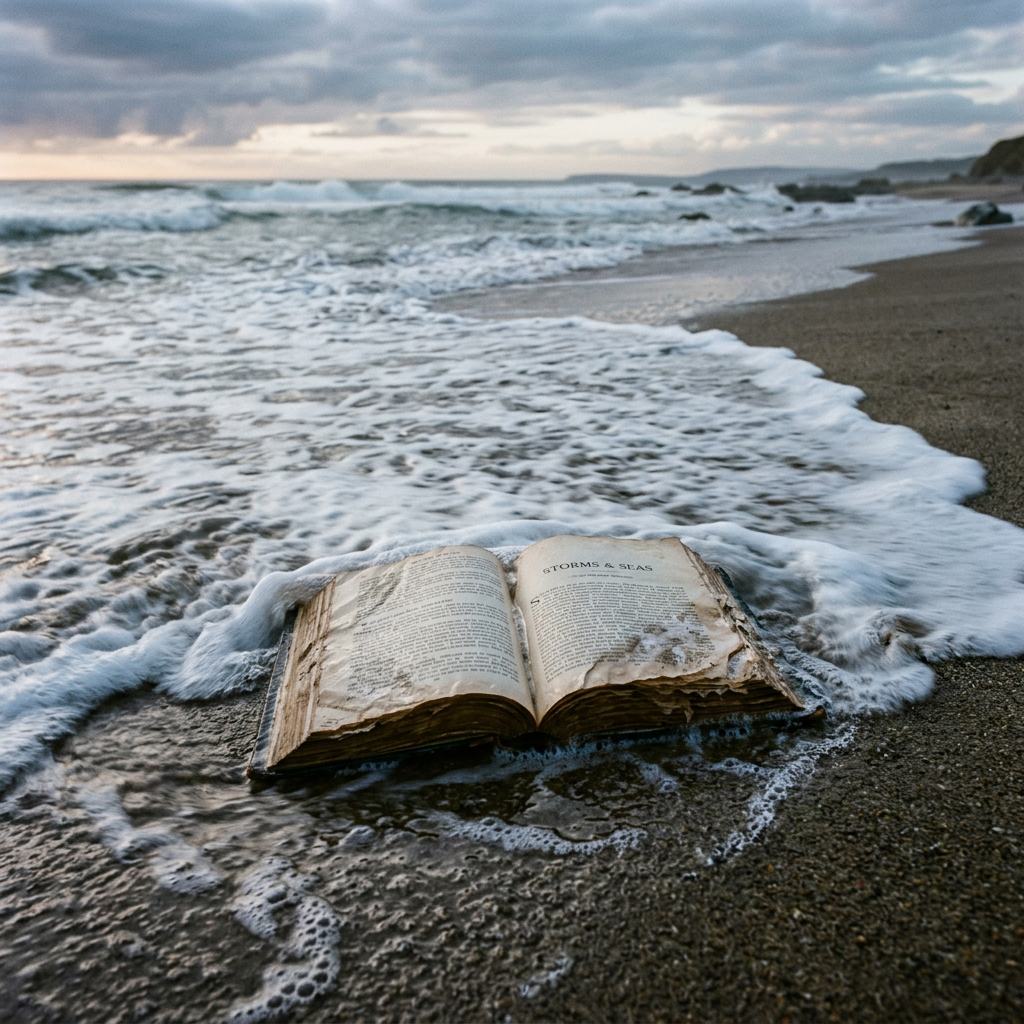
An old, worn book is partially submerged as ocean waves wash over it on a beach.
Hi Folks! Mercury in Retrograde goes back direct today. As my wise old spiritual counselor Leo would say, keep in mind that the mental fog tends to lift & clear up over the next 10 days or so. Also, be patient with left brain cognition & machines as they come back online during this time. In the meantime, please enjoy this new AI 2 person podcast as an appetizer for my newest book:
Ladies and Gentlemen…Introducing AI Podcast Characters Pip & Mara On Ari’s Multimedia Writing:
Pip: Climate grief, ancestral memory, and the kind of soul wounds that don’t show up on an X-ray — Classroom Mothership Earth is not pulling punches this week.
Mara: Ari Joshua Bouse has been publishing through Edge of Humanity Magazine, and the work lands squarely on climate change, trauma, and what we carry from those who came before us. Let’s start with the new published material and what it’s actually doing.
New Published Material
Pip: The through-line across these pieces is a question worth sitting with: what does climate change cost us emotionally, spiritually, and across generations — not just ecologically?
Mara: The series is titled “A Novel Read into the New Shorelines of Climate Change,” and the post announces it plainly: “Please see my newly published writings via Edge of Humanity Magazine.”
Pip: That framing — new shorelines — does real work. Shorelines shift. They don’t vanish cleanly; they encroach. Using that as a metaphor for what climate change does to inner life as much as coastline is a choice worth noticing.
Mara: The series spans three distinct pieces. The first is a poem called “Overcoming Deep Traumatic Soul Wounds” — which puts psychological injury right alongside environmental upheaval, treating them as the same conversation.
Pip: Which they arguably are. The literature on climate grief has been making exactly that case for a decade, and here it’s arriving as verse rather than a journal abstract.
Mara: The second piece, “Weathering Changing Weather Patterns,” shifts register slightly — the title itself is doing double duty, the literal and the internal sitting on top of each other. And the third, “Remembering Our Ancestors,” is another poem, this one pulling the lens back to lineage and what prior generations understood about living with a changing earth.
Pip: So you have trauma, adaptation, and ancestral knowledge — three movements that together make something closer to a full emotional map of the climate moment than any single essay could.
Mara: All three sit inside a larger project that Edge of Humanity Magazine is running under that “New Shorelines” banner, which suggests this isn’t a one-off but an ongoing body of work finding its public form.
Pip: Poetry as climate literature — not the most obvious delivery mechanism, but possibly the most honest one.
Mara: The shoreline metaphor keeps expanding the more you sit with it — what’s eroding, what’s being redrawn, what we’re trying to hold onto.
Pip: Next time, more from the edge. Worth watching where those shorelines move.
Please enjoy the previously published poetry excerpts from my latest book at the link below:
Swirling blue water blends seamlessly with layered, textured rocks creating an abstract pattern
Pip: Classroom Mothership Earth — where the curriculum includes otter medicine, elemental water, and the Sacred Feminine, and attendance is apparently taken by the universe itself.
Mara: Ari Joshua Bouse brings us into that territory today — feminine energy as a living force, what the otter symbolizes, and how all of it connects to the way we move through daily life.
Pip: Let’s start with the otter.
—
Swimming with Otter: Feminine Power and Letting Go
Mara: The central question here is whether we’ve lost touch with the qualities the otter embodies — playfulness, empathy, flow — and what it costs us when we have.
Pip: The post opens with the otter as a symbol and then turns it into a direct challenge, setting up the quote with a question about how we love: “Do you know the power of love without jealousy? Have you experienced the joy of loving other people’s kids and their accomplishments as much as your own?”
Mara: That’s the hinge of the whole piece. It moves from animal symbolism into something concrete — whether we can genuinely celebrate others, or whether we’re quietly keeping score.
Pip: And then it gets elemental. Earth and ocean as feminine forces, rivers flowing into the sea — the imagery is doing real conceptual work, not just decoration.
Mara: Right. The post frames water as a model for how energy moves: “Water gradually building momentum… Flooding us with waves of Sacred Feminine tides into our energetic seas.” The argument is that this quality — receptive, accumulating, eventually overwhelming — is something every person carries regardless of gender.
Pip: Which is where the otter stops being a nature documentary and starts being a mirror. Are you clinging to outcomes? Addicted to worry? The post is asking whether your daily operating mode is more like a dam than a river.
Mara: There’s a line that cuts through the more lyrical passages: “To accept the present moment as it is does not mean we condone what is.” That’s a careful distinction — presence isn’t passivity.
Pip: The piece also names the rescuer trap — running a constant crisis operation for everyone else while your own garden goes untended. That one lands.
Mara: And it closes with Mercury in Retrograde as a prompt to release left-brain control and move from intuition instead. Whether or not you track planetary cycles, the underlying point is about when calculation stops serving you.
Pip: The otter, it turns out, is just asking you to let go of the shore.
—
Mara: Feminine energy as flow, empathy as a practice, the present moment as neither approval nor surrender — that’s the terrain today.
Pip: More from the mothership next time. Bring your own river.
Students engage in a science lesson with Earth and space visuals surrounding them.
Pip: Classroom Mothership Earth — where the self-help mantra, the bumper sticker, and the geopolitical aside share a page without anyone blinking.
Mara: Today we’re looking at work from Ari Joshua Bouse — specifically a poem that moves from inner recognition and self-talk all the way out to questions of disclosure, technology, and what we owe each other.
Pip: Let’s start with the poem itself — and what it means to truly recognize yourself.
Recognition Poem
Mara: The post opens with a premise about self-perception: that recognition — of yourself and of others — is the starting point, and that self-criticism quietly erodes the ground you stand on.
Pip: The poem names fear as the specific mechanism. Here’s the line that anchors it: “Fear of consequence avoids taking responsibility.”
Mara: That’s the hinge the whole piece turns on. If fear of what follows keeps you from owning what you’ve done, you’re not just stuck — you’re actively building the wall higher.
Pip: And the poem doesn’t let the outside world off the hook either. It moves from inner work outward — through what it calls cognitive distortions, through “Us and Them segregations,” through the idea that karmic consequences exist even when they go unseen and unheard.
Mara: There’s a line that earns its place quietly: “A Higher quality of respect comes from feeling safe to learn, even through peaceful and non-violent forms of tough love.” That’s the connective tissue between the personal and the communal — safety as a precondition for growth.
Pip: The poem then takes a hard turn into territory you don’t usually find between a self-talk mantra and a Latin etymology lesson — and yes, it notes that discipline traces back to the Latin root for teaching, which reframes the whole concept.
Mara: The outer section addresses technology, fossil fuels, and what it calls Full Disclosure — the idea that taxpayers hold a sovereign right to know how their money works. The bumper sticker image is the vehicle: imagine the Air Force holding a bake sale, and then imagine further until there’s nothing left to fund.
Pip: It’s a rhetorical escalation — start with the absurd image, then keep walking until the absurdity becomes the point.
Mara: The closing lines bring it back: “the spotlight of heart-centered mindfulness lays the cards on the table to call out the bluff.” Awareness, the poem argues, is itself a form of accountability.
Pip: Recognition as the first act of honesty — toward yourself, toward others, toward the systems you live inside.
Mara: The thread running through all of this is that seeing clearly — yourself, your fear, your world — is where any real change begins.
Pip: Next time, we’ll see what else comes into focus.
A student gazes out at Earth from a high-tech space classroom
Check out this newly created experimental AI Podcast feature that aligns with my writing, compliments of WordPress.
Full Disclosure: Truly, I do take pride in my writing, and have yet to use AI for the written word. However, I have been having fun with playing around with AI for illustrations.
This podcast version of 1 of my more recent writings stars 2 AI created characters named Pip and Mara.
Please enjoy the podcast & transcript below:
Pip: Classroom Mothership Earth — where the daily writing prompt is “come up with a crazy business idea” and the answer turns out to be: civilization, but better.
Mara: Ari Joshua Bouse takes that prompt seriously, and today we’re following the thread — from a vision of shared consciousness and cooperative economics to what it actually looks like to clear space, inside and out.
Pip: Let’s start with the business idea itself.
—
A Crazy Business Idea For Co-creating A Beautiful New World
Mara: The post opens with a genuine question: what does an economy look like when the underlying operating system shifts — when interconnection is the default, not the exception?
Pip: And the answer isn’t a product or a pitch deck. It’s a paradigm. The post lays out what falls away when people genuinely feel their connection to each other.
Mara: The list is specific: “the institutionalized isms, trashing the park, wars, violence, gang banging, organized crime, the so called legitimate maximum-economic profit capitalist conditioning, economic strangulations, and the need to control each other fades away, and is released into a black hole in the Universe.”
Pip: That’s a sentence doing a lot of heavy lifting — and the point underneath it is real. The argument is that these patterns aren’t permanent features of human nature; they’re symptoms of a particular kind of disconnection.
Mara: Right, and the post is careful to say it doesn’t get killed or die — it transforms. The balloon metaphor follows: letting go of a thought form so it floats away, rather than fighting it.
Pip: There’s a friend in the piece who’s been sober from the news for over a year and reports genuine levity — less charge around politics, less reactive energy. That’s offered as a small proof of concept.
Mara: The post connects that to The Celestine Prophecy — James Redfield’s intention, quoted directly, was to inspire readers to “reclaim their power from dominant authorities and dysfunctional relationships: not via political or legal action but through a personalized spirituality that portrays life as a meaningful journey toward self-actualization.”
Pip: So the crazy business idea is essentially: skip the legal filing, go straight to the consciousness upgrade.
Mara: The post also gets concrete about physical space — imagining trash compressed in a way that literally opens up room, turning what looked like a landfill into ground for new growth. It’s the same logic applied materially.
Pip: And the T’ai Chi section earns its place. Professor Cheng’s instruction to “be like a ghost” — to create spaciousness — maps directly onto the economic argument: lead, follow, listen, don’t force.
Mara: The upshot is that cooperative competition, in this frame, isn’t naive. It’s more like push hands than a zero-sum match — sensitive to the other’s energy, not trying to overpower it.
Pip: Which makes the closing meditation clip feel less like an appendix and more like the actual deliverable.
Mara: That thread — from inner clearing to outer structure — is what the whole piece is building toward.
—
Pip: Clear the space, transform the pattern, don’t fight the balloon — it’s a coherent through-line once you follow it.
Mara: More from Classroom Mothership Earth next time.
Please enjoy the original post that inspired this new podcast version at the link below: