Recommended Reading

Daily writing prompt
What book are you reading right now?

Currently, I am reading the recommended books from the Mount Shasta spiritual retreat in mid-August 2025. Thus far, I have really been enjoying reading, and digesting the material in a way that is truly something to chew on, if you’ll pardon the novel literary pun.

These books include:

  1. The Symbol Of Life by Dr. Stylianos Atteshlis (Daskalos)
  2. Contact: Countdown To Transformation The CSETI Experience 1992-2009 by Dr. Steven Greer, MD
  3. The Book of Knowlege: The Keys Of Enoch by J.J. Hurtak
  4. The Spiritual Essence Of Man: The Chakras And The Inverted Tree Of Life by Master Choa Kok Sui

While at first glance; these books may seem heavy . . .

But rest assured, they are both grounding and filled with Light!

May You Walk With One Foot In Spirit and One Foot In Ground,

Ari

How Do I Balance Home & Work Life?

Ah, an age old question that does not seem to be disappearing anytime soon; for humanity at large at least.

Of course, humanity in general is addicted to work and it shows up in our lives in a myriad of ways. With this attachment comes with the price tag of negligence on the home front. Or maybe you don’t work enough, have the good fortune of meaningful work, or spend too much time on the couch and checked out from connecting with coworkers or people outside of your home?

Who doesn’t do this? Even asking the question points us in the right direction.

But it is important and no longer a luxury in our evolution to not give ourselves intensional time for non-linear and non-localized time as a powerful form of self-care. We need to do this to rest, recharge and keep ourselves online; in our brains, consciousness and otherwise.

I keep in touch with an old friend who gives himself time to daydream everyday because he realized he needed to build this into the structure of his daily routine. It’s different for yours truly because daydreaming is something that has always come naturally to me. If anything, I’ve had to learn to temper and contain this tendency; without squelching the gift entirely.

More importantly, we are human beings, not doings. And yet, we have been well trained or conditioned to feel fed and feed modern society with work to do and bills to pay. I remember when one of my clinical supervisors in social work school taught me that if you give 110% all the time, when you give 100% people will think your slacking. Reminds me of the American saying, keeping up with the Joneses.

In my experience, home and work life balance is not an exact science, and requires regular self-awareness and self-examination; not without giving mindful reflection and attention to peer feedback. As more priority is giving to a healthy holistic balance in home and work life, self-care is becoming more encouraged and accepted. For example, self-care is now in our Code of Ethics as social workers; as well as other forms of counselors working in the mental health field.

Furthermore, when I notice squirrels outside; I remember their wise spiritual guidance on learning the balance between work and play. These creatures reflect this important balance in life, and it is wise of us to heed their spiritual wisdom. I’m not sure there’s any other creature on the planet that are bursting with nervous energy. Squirrels have an incredible work ethic; and yet they seemingly integrate play while they work. I have spent more time than I care to admit meditating on how I and we can learn from squirrels in this way.

Giving ourselves time in Nature, and connecting with the animals and nature spirits is a powerful form of meditation that is so replenishing. As Lao Tzu would say, Nature is the best physician. I can’t tell you how many times I went into the woods feeling depleted or drained. After about 20 minutes, the forrest seems to embrace a human who is willing to sit, watch and listen.

And then as I walked out of the woods, a feeling of being refreshed and recharged magically awakened within. As with anything else, the seeing yourself experiencing this balance transforms itself when an intention and commitment to the mirror of the mind meditation is followed through with consistently.

In my profession, there is always something else we can do to help people. However, like one of my favorite life mantras that resonated from the book, Don’t Sweat The Small Stuff; the incoming box is always full, and the outgoing box is never empty.

Take care of yourselves everyone,

Ari

Plato’s Allegory Of The Cave

Daily writing prompt
Describe something you learned in high school.

Back in High School, one of my favorite classes was an elective called Humanities. The course was created by a great teacher who brought his theatrical personality, and philosophical spirituality to the classroom. In short, he embodied his humanity, if you’ll pardon the pun.

Our class ran like a group, which ended up being a precursor to some of my social work classes later on in graduate school. Seating arrangements could look like a traditional classroom with rows, or perhaps more avant guard small groupings of desks or resemble a horseshoe configuration. These seating arrangements and rearrangements are pretty typical and more commonplace in today’s classroom environment to help keep the energy flowing to facilitate the learning process.

In my case, going down multidimensional mind trips and wormholes wasn’t a new experience for yours truly. But in this class, the expanding group consciousness was unfolding in our classroom. In my experience, it was easier to come in and out of realms; somewhat akin to a UFO hovering in and out of dimensional bleeding between realities.

As always for yours truly, the classroom and school environment was anything but boring to a guy like me. To my teacher’s chagrin, it wasn’t typically the lesson plan that captivated my attention. Humanities class was a different story. We explored differentiation between Plato’s Republic and Pericles’ Democracy, our teacher’s own ‘Theory of Good’, and read Herman Hesse’s classic book entitled Siddhartha, among other curricula.

Looking back zen, Plato’s Allegory Of The Cave really struck a chord in me that has remained like a light flickering in a shadowy cave, if you’ll pardon the pun. This class really exposed some of the chinks in my armor that were key dynamics to my protective survival instincts at that time.

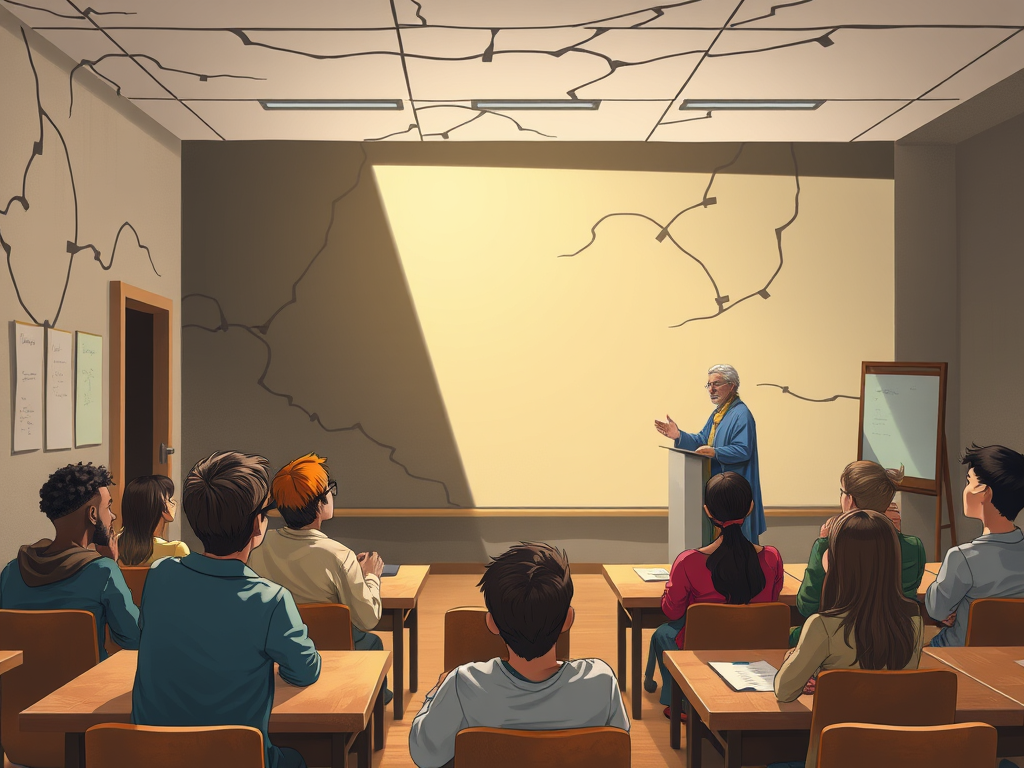
Furthermore, the metaphor of humanity being asleep and trapped in own own darkness lit a fire in my neurons and energy field. Death and rebirth were beginning to take root in my psyche, as they had done earlier in my formative years. I’d never heard of higher level thinking, metacognition or superconsciousness as common language experiences yet. But that didn’t stop me or others from having them. I remember when our teacher chalked up a simple diagram of his take on Plato’s Allegory of the Cave on the old school blackboard. As I reflect right tao, this visual resembles the ancient cave art we see from our ancestors. What can I say, the novel learning experiences still resonate.

Take care of yourselves everyone,

Ari

The Power of Transitional Objects Like Stuffed Animals, Security Blankets, etc.

Daily writing prompt
Describe an item you were incredibly attached to as a youth. What became of it?

Compliments of AI, the images above capture the sentiment of the time when my mom and I got in a power struggle when I was about five years old. Like Linus from the cartoon Peanuts, I brought my blanket (blankie) everywhere, and was about to over my bring it into the bathroom with me. Typically, my mom was good at what we call in Therapeutic Crisis Intervention (TCI) ‘dropping the rope’, and avoiding power struggles. But this time, mom wasn’t going to budge, grabbed what psychologists today call ‘transitional objects’, and tried to pull my blankie away from me.

Given my strong will and formidable attachment to this object, I was having none of it. Thus, it didn’t take long for the blanket to part like the Red Sea, and tear right down the middle. Immediately, I started crying and so did my mom. After we calmed down, and processed the incident; mom apologized, told me how bad she felt and then expressed that she was really worried about me trying to take my blanket to school, getting in trouble and being made fun of by my peers. I don’t blame her; especially because I had already been profiled young, and had to go to a special purpose Preschool program to rework my difficult behaviors. She remembered the look they gave her when I showed up for the first day of the new Preschool with my cowboy guns in holsters. And then the staff turned towards her and said, “we don’t encourage guns in school.” Given that experience, her desire to help- and that I had already got into trouble with another peer on Kindergarten’s orientation day, I can see how she got sucked into this power struggle with me.

Looking back, I remember being struck with how rigidly she had set the limit; seemingly abruptly, and then held her ground without budging. Mother and I revisited this episode many times over the years, and would always laugh about it. The storytelling was a precursor to my journey in meditation, our relationship with our attachments, and how we approach working with them. This experience also informs how we can more effectively co-regulate with each other, and navigate transitions between structured, unstructured, preferred and non-preferred activities. Besides, the blankie was already about to set itself on fire, and was no longer salvageable. The agreement was that I would get a new blanket to replace the old one but under the expectation that the new one would not be going to school with me. During my career as a school social worker, I have told this story many times to students, parents, staff and coaches when situations like these have come up. Like the old T’ai Chi Master Professor Cheng used to say, learning to be human isn’t always easy, and is a lifelong developmental process; our attachments notwithstanding. Humor gets us to look at things differently, and is a powerful change agent in the transformational process of relaxing and letting go of our attachments.

Origins

Daily writing prompt
Where did your name come from?

Ari means Lion in Hebrew. My dad felt a deep connection with Jewish religion and nearly converted after reading and being inspired by the book The Exodus. Ari was the hero in the book. Also, a film adaptation of the book was made. Ari was played by the late actor Paul Newman.

“In Exodus, Uris tells the story of the Jewish people’s struggle over the past three thousand years: their exile from Israel, oppression in all corners of the world, the genocide of the twentieth century, and ultimately the bloody War for Liberation that they fought in order to establish the Jewish nation of Israel.”

There was a period of time that my dad went by Ari as a nickname. In my baby book (in my mom’s handwriting) my dad was identified as Ari, Sr. She was good like that. My mom wanted to name me Joshua, which is my middle name. She was good like that too. I always thanked her for the compromise because I prefer my given name the way it is. I love all animal but cats are still my favorites and I still root for the Detroit Lions football team.

Strategies To Maintain Health And Well-Being

Daily writing prompt
What strategies do you use to maintain your health and well-being?

For many years now, I have maintained a consistent everyday meditation practice and get out alone in Nature at least once a week, where I hike for a bit and then sit with the animals. This is akin to my place of worship, where I always walk away feeling recharged from connecting with Spirit. Sitting in the elements during the four seasons and watching the animals do their thing has taught me a lot about myself and other humans in the social environment.

After taking over a 20 year hiatus of working out in the gym, I finally rejoined last week because I realized I was missing having a place to go to exercise at a positive community connection. After investing in my own equipment and 20 years of being consistently inconsistent, and then a global pandemic, I realized I needed to get back to basics. Going to the gym was something that carried me through my adolescence for making healthy choices. The gym was a place where I could go everyday or almost everyday, in spite of whatever else was going on in my life. It was a good transition from school, home and life’s responsibilities. As I approach a half of a century in my life cycle, it felt like the right time to elevate my game in this way.

Also, I drink about a 100 ounces of water a day and start my day with a superfood green drink mixed with a shot of apple cider vinegar and wash it down with some other supplements like DSF, glucosamine, fish oil and D3 when cooler weather and darker days come about. I take a blend of Chinese herbs for seasonal allergies or if I sense a cold coming about. It might be all downhill from there, but my morning routine of meditation and the green drink are a great way to start the day.

Also, I do tai chi and qigong everyday. Doing these make for a great pre & post workout warmup & cool down, as well as moving and still meditations for mind-body-spirit connection. And being mindful of my thoughts and focusing on positive self talk has been a keep dynamic in this area. Writing, playing my guitar, harmonica and singing have all been instrumental strategies as creative forms of artistic expression that support health and well-being. It is my good fortune to have meaningful work, which is also a key dynamic for health and well-being. Getting a good night sleep is a key dynamic in my regular daily routine.

Changes In Modern Society

Daily writing prompt
What would you change about modern society?

Flip the script by pouring resources into education, mental health, healthcare and treatment. Teach every child mindfulness and meditation as a way of life. Reverse the momentum to promote the human factor, as well as support all sentient beings to co-exist peacefully. Support a free thinking society that is in alignment with the Universal Pillars of Love and Truth. Encourage our citizenry to become active participants rather than merely spectators. Sports are just games. Politics are not. An awakening society understands this as self-evident.

Unlock the technology that we have been sitting on for the last 100 years at least to provide clean, free energy to everyone on the planet. Stop weaponizing this technology and get rid of nuclear weapons and other weapon of mass destruction. Come clean about ETs and the existence of the Secret Government.

Incentivize a more fair, just and equitable society by making it convenient for people to do the right thing regarding taxation with representation. Do away with maximum economic profit as a preferred way of doing business. The societal triangle should look more like an equilateral triangle, with far less emphasis on hierarchy and more intention on horizontal bottom up-top down synergy. The billionaire class pays their fair share, while everyone else gets what they need. Fair isn’t that everyone gets what they want, fair is that everyone gets what they need. Everyone’s basic needs are met and have equal access to resources.

Institutionalized oppression, such as racism and classism are gone with the wind, in a way that reads like a parody of an old fairy tale that you’re embarrassed to read to your grandchildren. That tired old documentary is seen as an old fossil that reminds us that we took the right step in our evolutionary shift in consciousness. Nurture win-win politics. See the Planet and Universe as a living organism that we are all part of, working together for mutual aid. Society honors our Diversity Within Unity. There is a systemic intention and commitment to supporting this collective shift in the soul of our Global Village and beyond.

Letting Go For The Sake Of Harmony

Daily writing prompt
What could you let go of, for the sake of harmony?

Harmonizing with my environment is a spiritual discipline. As I let go of my need to be right, harmony is welcomed in. For example, it just seems to disarm whatever defenses mechanisms I’ve fortified myself with on the inside, and then transforms into a more light-hearted sense of detachment. When I let go of my need to be right, there is an awakening of harmony.

Expressing My Gratitude

Daily writing prompt
How do you express your gratitude?
Photo by Alexas Fotos on Pexels.com

The most important way I express gratitude is by setting an everyday intention and commitment to have an attitude of gratitude as a way of life. Every morning before I get out of bed, I remember this mantra before my feet hit the floor, and wake up expecting synchronicity. Also, I conclude my morning meditation practice by saying “thank you” three times. Practicing random acts of kindness without a sense of betting something back in return amplifies the experience.

As I go about my day, regardless of what my moods or feelings might be, I try to enjoy the little things. And even if I don’t, I work on appreciation, acceptance and even embracing what is. Yes, inner peace can be more challenging when any given situation is asking me to come out of my bubble or see the blessing that might be brilliantly disguised within the apparent curse. One way I have been pushing my edge with this is working building gratitude for and relaxing my judgments about provocative adult emotional reactions.

Positive self talk helps a lot. But so does allowing the negative self talk to pass with care as gently as possible without trying to push them away or throw them in the trash. I try to remember to have an open, passive attitude to whatever the moment calls for. Watching my thoughts and feelings like clouds and sometimes even thanking them for showing up helps me stay in a place of gratitude.

And I try to use “I-messages” as a form of effective communication. For example, if I am asked to do something at work or at home that I don’t want to do or having a hard time with, I’m getting better at asserting myself by saying something like, “I really don’t want to paint the house and would rather pay someone else to do the job. But I’m not unwilling to do the job and am open to having a conversation about it.” This has been hard for me because I don’t like disappointing people. When I do that, I find that it isn’t about getting my way, it is more about speaking my truth and then letting go of it so that I don’t build resentments. Sometimes, saying no is saying yes.

When gratitude is my inner state of consciousness, I feel less seduced by the clinging or grasping of whatever presents itself in the theater of life.